By Quentin Langley
Politics is an arena in which brands have always spent a great deal of time and money defining the brands of their rivals. In commerce, this is much rarer. While comparative advertising happens, outright negative campaigning in business is unusual. Perhaps this is why brandjacking so often takes businesses by surprise, and also why political groups such as Greenpeace can be so effective at bringing this political skill to business campaigns.
The feeling people have that this year's American election has been exceptionally negative is borne out by academic research. Politico has produced the following chart:
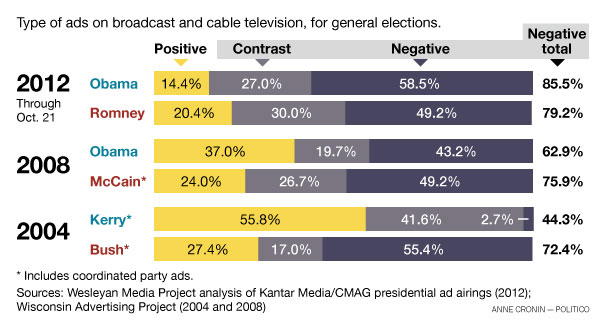
A couple of caveats. This lumps together candidate and party ads, but not those by non-coordinating groups, which are often even more negative. At one point (though the law has changed on this) non-coordinating groups were not allowed to put out supportive ads.
Second caveat, this takes no account of the honesty or relevance of the content. To take two imaginary examples, an ad which pointed out that unemployment had risen under President Obama would receive exactly the same rating (negatie) as one that called him a Kenyan Satanist in the pay of the Chinese Communist Party. Similarly, the true but irrelevant point made forcefully by Brian Schweitzer, that Mitt Romney's father was born in a "Mormon polygamy compound" is simply rated as 'negative'.
The striking change since 2008 is, of course, on the Democratic side. But it is worth noting that the circumstances of this election are very different. Last time there was an obvious case for being positive. The election was open. The President was not on the ballot. Insofar as anyone was running against the President, it was Obama. Which is why it is surprising that the McCain campaign was so negative. This time Mitt Romney is running against the President, so the case for negative or contrast ads from him is, obviously strong. On the Democratic side the case is rather different, and seems mostly to be that the President can't run on his record, because his record is bad, so he has to run against Romney. The hope is gone, and now it is all about fear.
This table from the Wesleyan Media Project tells another important tale:
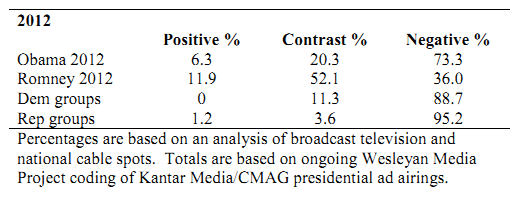
I have to say my instinct as an advisor would be to urge the official campaigns to focus on positive and (maybe) contrast ads and leave negative campaigning to outside groups. Given that the official campaign ads inclue "I am Barack Obama / Mitt Romney and I approved this message" I would want to avoid putting that alongside a negative message. The somewhat high negative messaging from Romney and massively high proportion from Obama is therefore a little surprising. That said, there are many other factors around who runs a particular ad, including how much money the groups have available.
Given that political campaigns evidently believe that negative campaigning is successful, business needs to prepare itself for an avalanche of brandjacking as campaigners are increasingly brought in to campaign on commercial issues.
If Barack Obama loses today, look forward to large numbers of left-leaning political campaigners reinforcing NGOs in January next year.
 Brandjack News
Leave a comment