• By Quentin Langley

    Zach Braff is a talented comic actor. I greatly enjoyed his work in Scrubs. The film, Garden State, which he wrote, produced and directed, as well as starred in, was very successful. I neither dispute his talent nor resent his financial success. But I don't see the slightest reason why I should give him money. That is not because I am especially stingy. I do give money away. I sponsor Reeta Kumari through Plan UK. The money that my wife and I send means that Reeta is able to stay in school, something which all too many girls in India are unable to do. I just can't see Zach Braff in quite the same light. Garden State took over $35 million, and I don't see any reason to make charitable donations to people who are that much richer than I am.

    You may not have heard that Zach Braff is seeking such donations. Well, he is, via the fundraising website, KickStarter. KickStarter is a valuable service that enables marginal projects, such as artistic ventures, to raise money via crowdfunding. I am all for it. There are plans afoot to let start up businesses raise funds in similar ways. This is great. But Braff's venture is not seeking investors, it is seeking donors.

    He wants to raise money without his artistic vision being compromised. He fears that "the money-men" would want too many changes to his script. The "money-men" are, of course, experienced investors with a lot of acumen about what will sell but, hey, it certainly seems possible that they would be over-cautious and pass up a risky project with potential returns as spectacular as Garden State – which cost just $2.5 million to make. If this were an investment, I might take a punt on Braff. He has a good record. Maybe he could earn me a good return. But it is not investment he is seeking, but donations.

    For a donation, you might get your name mentioned in the film, or a visit to the set, or even appear as an extra. That last one is pretty cool, eh? Most films pay their extras. This one is charging them $2,500.

    Good actor. Good filmmaker. Funny man. Definitely not worthy of any donation from me.
  • By Quentin Langley

    The publicist for controversial performance artist, Beyonce, "respectfully" asked Buzzfeed to remove several "unflattering" pictures of the star from its site. Buzzfeed declined to comply and the email has since become public. Buzzfeed describes the shots as being among the star's "fiercest" moments from her Superbowl performance. The controversy has now started a meme in which the 'fierce' pictures of Beyoncé are photoshopped into ever less flattering poses.

    It is difficult to imagine that the publicist thought asking for the pictures to be removed was ever going to work. Instead Ms Knowles is finding herself once more a focus of controversy. Once someone reaches the level of power, wealth, and influence that she has, it would be wise to develop a softer and more human side. Apologise for some of the egregious breaches. Acknowledge the inspiration of other artists. Learn to laugh at the occasional unflattering photo.

  • By Quentin Langley

    The product description at Amazon says:

    BIC Cristal For Her has an elegant design – just for Her! It features a thin barrel designed to fit a women's hand. It has a diamond engraved barrel for an elegant and unique feminine style.

    The reviews are less flattering. Reviews rise to the top at Amazon through community votes and extracts are quoted and featured, again from those reviews with a large number of positive votes or where large numbers of people have made substantively similar points. The featured extracts include one woman ironically praising the product on the grounds that she has been using "cumbersome man's pens" and another saying that she had planned to buy one but been forbidden by her husband. 

    The reviews are in similar vein, talking about how the pens are especially good for drawing pictures of ponies and kittens but, of course, don't work for maths. Another complains that it does not appear to be batttery powered and is not the "for her" product she had in mind at all.

    The algorithm at Amazon is very powerful and reflects the views of community members. There are some products that just shouldn't be sold at a site like this, or which should be sold with rather less patronising blurb. This doesn't seem to be an abuse of the review process – as in flashmob reviews – just a reaction that reflects the views of Amazon users.

  • By Quentin Langley

    When a relatively obscure folk singer, one whose career, according to The Daily Beast, peaked in the 80s and 90s, is criticised for a homophobic rant and the apologises saying she was misunderstood a few days later, it is easy to be suspicious. Was this just a publicity stunt? Shocked says she is not that clever. I'd have to go along with that. If this was a publicity stunt, it was most certainly not a clever one. In the days of social media, all publicity is most certainly not good.

    What are we to read into the singer's choice of stage name? Shocked? Was shocking people her objective? Secondly, how are we to interpret her, frankly, confusing claim that her shocking remarks were a "social experiment", especially in the light of her previous, rather mixed, stances on homosexuality?

    In the past she has been associated with progressive causes, and has, at least, hinted that she might be lesbian. But in the 1990s she joined a church choir and became a born again Christian. She told a newspaper in 2008 that the bible describes homosexuality as a sin, but no more or less of a sin than fornication, going on to concede that she is "a fornicator with a capital F". A measured comment such as that remains controversial, but is not shocking. Her comments in San Francisco – of all places! – a few days ago that "God hates fags" and that gay marriage would bring on the apocalypse cross a line that can't be uncrossed. There are many subjects on which reasonable people can disagree, but asserting that God hates a group of people puts the speaker outside reasonable debate.

    To turn around a few days later – a few days of silence and cancelled gigs – and to claim that the views she expressed were not her own: she was merely repeating what some people – emphatically not including herself among those some people – believe. Asking people to tweet the God hates fags remark was a social experiment to see how many people would.

    Does anyone find that credible? 

    The days of Barnum and Bailey are long gone, and the days of Max Clifford are coming to an end. It isn't just about publicity any more, when any remark you make – or pretend to make – can be exposed and analysed in seconds. All publicity is not good publicity, and Michelle Shocked has the cancelled gigs to prove it.

  • By Quentin Langley

    It is Superbowl Sunday in a few days, and one of the obsessions in the media is the ads that will run in one of the most expensive slots of the year. Sometimes companies deliberately court controversy to get maximum coverage around the ad, as well as the exposure of the slot itself.

    Is that VW‘s plan with this ad:


    A white guy, apparently from Minnesota, with a Jamaican accent. Is that racist? Well, not all Jamaicans are white, and someone “from” Minnesota could have previously lived in Jamaica. But there is no doubt that the Jamaican accent is most often associated with black people. This may be less so in the US than in the UK, where a significant proportion of the black population are of West Indian descent. 

    Using the Jamaican accent to communicate happy and laid back would seem to be an example of stereotyping. Is it negative stereotyping? Well, potentially. Labelling black people as laid back may seem complimentary, but it also implies someone who is not driven and career focused. 

    So far, VW seems to be doing quite well in the debate. The Jamaican government seems happy, and thinks the ad may boost tourism. It is probably worth exploring the fact that for a German company, this is a counter-stereotype. VW may be trying to communicate that, as a company, it is not just efficient with excellent engineering, but its products can be fun too. 

    But stereotyping is usually best avoided. This consultant would have advised against.

  • By Quentin Langley

    There are rules for how you manage your reputation in a crisis. Terence Fane-Saunders of Chelgate best sums up the most important: be the person telling your story. If you don't tell your story, someone else will.

    Carnival, owner of the Costa Concordia, is still generating a great deal of negative coverage a year after the ship capsized. It is not easy to discern who is telling Carnival's story. But there is a story to tell. Unfortunately, Carnvial seems to have fallen out with some of those best able to tell it.

    The precise circumstances which caused the accident and the deaths of 32 people are the subject of both civil and criminal trials. But the dominant story in the immediate aftermath of the shipwreck was of the recorded confrontation between the coastguard and the captain. The coastguard became something of a hero, with some Italians declaring he rescued the country's reputation. HIs instruction to the captain "vada a bordo, cazzo" – "get the fuck back on board" became a popular tee-shirt adornment. 

    The captain was the most senior representative of the company on the spot, and, as a spokesperson for Carnival he seems tainted. But there were over 1,000 crew, and there are heroic tales to tell. There was another captain on board – the captain of another Carnival cruise liner, travelling as a passenger. Apparently he was involved in organising passengers for evacuation.

    And then there is the dancer, Rose Metcalf. Most of the crew and staff were entertainers, with no particular expertise in ship's procedure. Rose found herself marshalling passengers, because no senior crew were available at her muster station. At one point, Rose posted a message to Facebook asking her friends to pray for her. She was one of the last crew to be rescued. She is now an advocate for ship safety. But she doesn't work for Carnival – she is engaged in a legal dispute with the company – she works for a law firm.

    Could Carnival not see the potential value of using one its heroes as an advocate for ship safety? Could it not see the reputational damage of being caught up in a legal dispute with her. It does her no harm, of course, that she is photogenic, and a native English speaker. 

    This blog must declare a tangential interest. Rose Metcalf was a student of the editor's wife, who teaches choreography and dance technique. But it seems obvious to this, only slightly biased, observer, that Carnival should be telling its story via the people who behaved well on the night the ship went down, not via those who behaved badly. 

    There are principles of crisis management, Carnival: vada a bordo, cazzo. 

  • By Quentin Langley

    Would it matter if Beyoncé's performance of the national anthem at Barack Obama's inauguration was a lip-sync performance to a pre-recording. It sounds a bit lame. She is a highly paid performance and recording artist. If this was just a recording, why did she even need to be there? On the other hand, there is little doubt that it was her voice and her performance. By contrast, her choreography remains subject to considerable controversy  about its originality.


    The controversy seems to stem from contradictory information from the US Marine Corps band. A spokeswoman stated that Beyoncé opted for a pre-record, but another statement stated that they were not in a position to assess whether it was a live performance or not. 

    Does it matter? Well, it does seem that she should keep better faith with her fans.


  • By Quentin Langley

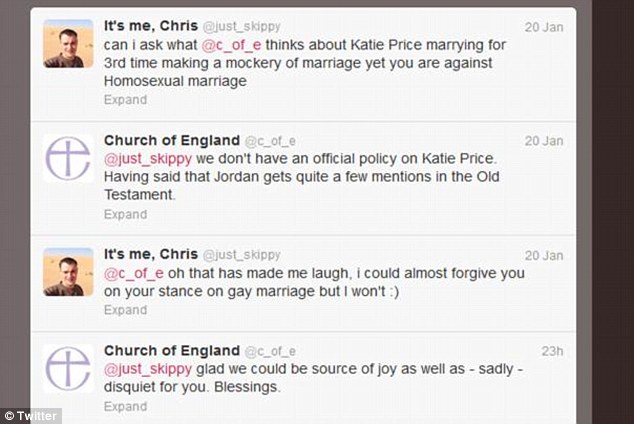
    The Church of England has come under fire for an "offensive" joke about gay marriage and the glamour model, Katie Price, also known as Jordan. Reviewing the tweets it is difficult to find anything offensive in them. Indeed, on an issue which breeds deep passions and strong feeling of offence, deflecting the issue with humour was probably the only way of handling it without causing offence. 

    Cofetweets

    There? Offended yet?

    This is a particularly difficult issue for the C of E, which is deeply divided on gay marriage. Your columnist is hardly an expert on theology, but finds it easy to imagine that many other religious organisations – some evangelical churches, for example, or the Quakers – could take a firm stance without, at least, causing any internal offence. Their position would, however, offend many others. The C of E cannot even avoid internal conflict, other than by deflection.

    On the whole, every neatly handled.

  • by Quentin Langley

    Time magazine seems to be struggling this year to find a Person of the Year. Unusually, there is no stand out candidate. This blog suggests they consider Martha Payne.

    That Martha has raised enough money to build 17 kitchens in Malawi, for people who would otherwise have no access to a hot meal, is remarkable enough. But Martha is also symbolic of the way in which global power structures are being turned upside down. In mere hours – hours which Martha spent in class in her primary school – her local council was forced into a humiliating climbdown over their plans to silence her blog.

    For a day, Martha Payne and her NeverSeconds blog were trending on Twitter as people all over the world demanded that Argyll and Bute Council back down. This was a nine-year-old girl. All she wanted to do was blog about her school lunches and raise money for people in Malawi. It took just half a day for the council to surrender to the inevitable and back down.

    Since then, Martha has travlled to Malawi and seen for herself the good that her Just Giving page has done.

    The world has changed this year, and Martha Payne is a symbol of those radical changes.

  • By Quentin Langley

    There are few countries in which a case of acute morning sickness can have constitutional implications, but for sixteen Commonwealth realms, that is the case today.

    Monarchy is, let's face it, a question of branding as much as the constitution. Hence its legitimate place in this blog. A head of state – except when also head of government, something rather unusual in decently run countries – is purely symbolic, and monarchs are very much more effective symbols than presidents. A visit by the British Queen or the King of Spain to, say, the US, is sure to be a much bigger deal than any visit by the president of Germany or Italy – whoever they happen to be at the moment.

    But what does a case of acute morning sickness – with all its implications for the soap opera that is world's most famous family of celebrities – have on the constitution? Well, acute morning sickness has a positive correlation with multiple pregnancies, and the succession to the throne in the Commonwealth realms is governed by male cognate primogeniture. Both men and women can succeed, but the male line takes precedence, so a son born to the Duke and Duchess of Cambridge will succeed ahead of an older sister. This cannot have any implications until they have at least two children, and only then if they have a girl followed by a boy. But the possibility of a multiple pregnancy suggests that such a scenario might be mere months away.

    While a change to the line of succession was discussed at the Commonwealth Heads of Government Conference last year, it is unlikely that there would be significant objection from any of the affected countries. It is important that the line of succession be free from controversy. It also seems worth noting that women have a pretty good record in office. In any list of Britain's greatest ever monarchs, Queen Victoria and both Queens Elizabeth would be likely to feature strongly. 

    We must not blow this issue out of proportion, though. Monarchy, as long as it exists, is never going to be an equal opportunity employer. And, in the 290 years since governance passed from the monarch to a prime minister, the UK has had two queens regnant and only female prime minister. Canada and Australia have each also had just one female PM. Of the major Commonwealth realms, only New Zealand (the first country to give women the vote) has had two women at the head of its government. If we judge monarchy not by the number of instances women have been at the top, but by the length of time, women do even better, holding office for some 42% of the time since 1721, throughout the 63 year reign of Queen Victoria and the sixty years and counting of Queen Elizabeth II.  

    Nonetheless, the time to act on this issue is now, when it does not affect any particular person, since first and second in line to the throne are both male anyway. But the timescale for which this is the case just got a whole lot shorter.