• By Quentin Langley

    Journalists never seem to challenge the sanctimonious posturing of Hacked Off – a campaign against press freedom supported by left-wing academics and celebrities who want the media to report the nice parts of their life and stop exposing their hypocrisy.

    Spokespeople for Hacked off appear in the media fairly frequently, but are rarely challenged on their illiberal agenda. Hacked off asserts that recent media scandals demonstrate that self-regulation has failed and this demonstrates the need for statutory regulation. In other words, the campaign proceeds from a deliberately false premise via invalid reasoning to a predetermined conclusion of demanding political control of the media.

    The false premise is that self-regulation has failed. Plainly, no regulatory system is flawless. Any system will make errors or miss important things. But recent scandals have focussed on criminal behaviour by journalists such as hacking phones and bribing police officers. To say that such criminal behaviour demonstrates that self-regulation has failed and there is a need for statutory regulation is intellectually risible. Phone hacking and bribery are already regulated by statute. It is statute – the criminal law – which has failed in this instance.

    I will not repeat their error of logic by declarling that, since statutory regulation has failed, it is obvious that hacking and bribery should now be governed by self-regulatory frameworks. This would be an absurd conclusion. Even if Hacked Off's claim that these matters are presently subject to self-regulation were not blatantly false, their logic would still be absurd. The fact that one system of regulation has failed does not demonstrate that any particular alternative would be better.

    But the fact that journalists on Sky (currently subject to statutory regulation)and the BBC (the only medium which actually does regulate itself) do not challenge either the falsehood or the faulty logic demonstrates that the Hacked Off campaign is working. It is having the effect of intimidating journalists from challenging the powerful: the cloistered academics and the rich celebrities. These people get away with peddling any old crap precisely because they have cowed journalists with their calls for political control. 

    And this is real danger of Leveson and political conspiracy in favour of censorship: they do not have to control the media if they can intimidate them.
     

  • By Quentin Langley

    Starbucks is being heavily criticised by campaigners and the media over its UK tax position. The background is anti-austerity campaigners, UK Uncut, criticising wealthy individuals and businesses for structuring their finances in such a way as to minimise tax liability. This is compounded in the case of businesses by sloppy and biased reporting in the broadcast media which compares corporation tax paid with the turnover of a business and not with the profits against which it is assessed. This is the intellectual and moral equivalent of comparing your income tax liability with the value of your house and not with, say, your income.

    Starbucks actually paid no UK corporation tax last year. It continued to levy VAT for the government and to collect income tax and national insurance on money paid to its employees.

    According to social media research agency Yomego, suggests that customer satisfaction ratings in social media have fallen dramatically in recent weeks, though they remain in positive territory. Some 95% of comments contain some reference to the tax issue.

    h/t BrandRepublic


  • By Quentin Langley

    Celebrities who make their endorsement available to the highest bidder pretty soon won't have any bidders.

    The latest story of Oprah endorsing Microsoft Surface in a tweet sent via Twitter for iPad is embarrassing, but may or may not fall into this category. So far, there is no explanation. Does Oprah really like Surface, but uses the iPad for Twitter? That would seem bizarre. Could someone from her team have been tweeting Oprah's real opinions, but doing so from their own preferred device?

    But if it turns out that Oprah has endorsed Surface for a fee while personally preferring iPad, it will be extremely damaging to her brand.

    Oprah is widely trusted for her integrity. Her show has the power to bring massive exposure to small and medium-sized businesses. 

    Claiming that you like Surface while actually preferring iPad seems trivial compared with endorsing Ramzan Kadyrov (see previous post), but this could very well hurt Oprah's reputation a great deal.

  • By Quentin Langley

    The theory of six degrees is welll known, and has spawned the excellent game "six degrees of Kevin Bacon". Anyone who works in film or tv has a Bacon number.

    But, just for a moment, think about someone you know who is especially well-connected. Someone you think of as a great networker. The chances are, it is someone who is deeply connected: someone who knows a lot of people in one place or one industry. Deep connections are valuable, especially in networking your way into a new job. Connections in your profession or your sector are, obviously, the sort of people who will hear about jobs that are of interest to you. But the very best connected people – the ones will low Bacon numbers or close connections to Barack Obama; the people who are a maximum of five or even four degrees separated from anyone – are the people with good random connections. It is the surprising people in your network who open up vast swathes of new connections.

    So here is your networking challenge. You can use LinkedIn, Facebook, Twitter or any other social media platform. The platform is not the point. The point is to add six new connections in 24 hours meeting the following criteria:

    1. At least one must be someone who lives on a continent on which you have never lived. (If you have lived on six continents, you are excused this one).  (I have to rule out Europe, North America and probably Asia. 'Probably' because I lived in Georgia, on the Eurasian border, for a while).
    2. At least one must work in a profession in which you have never worked. (I have to rule out PR, academia and head hunting).
    3. At least one must work in an industry or sector in which you have never worked. (I have to rule out education, consultancy, energy/utilities, media, real estate, accountancy, and probably some others).
    4. At least one should be a referred contact by a member of your family.
    5. At least one should be a referred contact by a former professional colleague.
    6. At least one should be someone who strongly disagrees with you on something important (as evidenced by, for example, their blogging).

    Okay, you ready?


  • By Quentin Langley

    Politics is an arena in which brands have always spent a great deal of time and money defining the brands of their rivals. In commerce, this is much rarer. While comparative advertising happens, outright negative campaigning in business is unusual. Perhaps this is why brandjacking so often takes businesses by surprise, and also why political groups such as Greenpeace can be so effective at bringing this political skill to business campaigns.

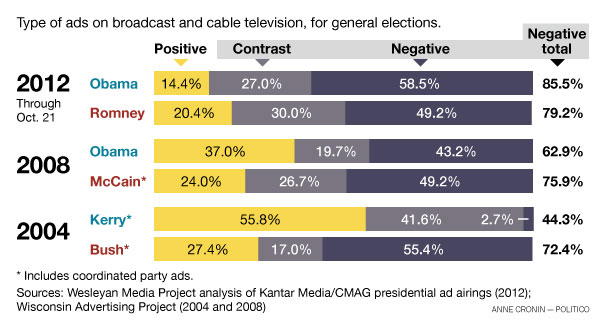
    The feeling people have that this year's American election has been exceptionally negative is borne out by academic research. Politico has produced the following chart:


    121103_negative_ads_graphic_cronin_605 (1)
    A couple of caveats. This lumps together candidate and party ads, but not those by non-coordinating groups, which are often even more negative. At one point (though the law has changed on this) non-coordinating groups were not allowed to put out supportive ads.

    Second caveat, this takes no account of the honesty or relevance of the content. To take two imaginary examples, an ad which pointed out that unemployment had risen under President Obama would receive exactly the same rating (negatie) as one that called him a Kenyan Satanist in the pay of the Chinese Communist Party. Similarly, the true but irrelevant point made forcefully by Brian Schweitzer, that Mitt Romney's father was born in a "Mormon polygamy compound" is simply rated as 'negative'.

    The striking change since 2008 is, of course, on the Democratic side. But it is worth noting that the circumstances of this election are very different. Last time there was an obvious case for being positive. The election was open. The President was not on the ballot. Insofar as anyone was running against the President, it was Obama. Which is why it is surprising that the McCain campaign was so negative. This time Mitt Romney is running against the President, so the case for negative or contrast ads from him is, obviously strong. On the Democratic side the case is rather different, and seems mostly to be that the President can't run on his record, because his record is bad, so he has to run against Romney. The hope is gone, and now it is all about fear.

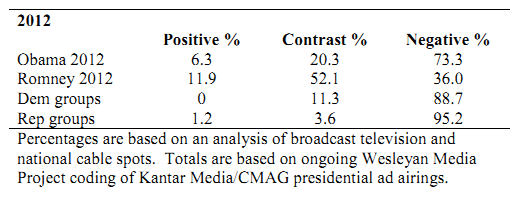
    This table from the Wesleyan Media Project tells another important tale:

    2012 ads
    I have to say my instinct as an advisor would be to urge the official campaigns to focus on positive and (maybe) contrast ads and leave negative campaigning to outside groups. Given that the official campaign ads inclue "I am Barack Obama / Mitt Romney and I approved this message" I would want to avoid putting that alongside a negative message. The somewhat high negative messaging from Romney and massively high proportion from Obama is therefore a little surprising. That said, there are many other factors around who runs a particular ad, including how much money the groups have available.

    Given that political campaigns evidently believe that negative campaigning is successful, business needs to prepare itself for an avalanche of brandjacking as campaigners are increasingly brought in to campaign on commercial issues.

    If Barack Obama loses today, look forward to large numbers of left-leaning political campaigners reinforcing NGOs in January next year.


  • By Quentin Langley

    "The evil that men do lives after them, the good is oft interred with their bones," said Shakespeare's Mark Anthony. According to the notion of karma, one is set against the other to produce a karmic balance. 

    If we accept, arguendo, that the allegations of serial rape and sex with under age women are true, then it would seem that no record of success in charity fundraising can offset that evil. But the raising of more that £40 million plus many years of voluntary work as a hospital porter still counts in Savile's favour. The charity work and the predatory sexual behaviour are logically unconnected. But were they psychologically connected. Did Jimmy Savile's guilt at his sexual predation spur him on to help Stoke Mandeville hospital?

    Some people argue that corporate social responsibility is a figleaf for bad behaviour by corporations. But, if so, this cannot ever work. We only have to think of Jimmy Savile's reputation to see why. Now that the allegations have become public his hitherto saintly reputation has taken a well-deserved nosedive. No quantity of charity work can undo rape. Indeed, it is easy to imagine Savile's victims having to regularly relive their trauma every time they saw him praised for his fundraising.

    CSR has to be much more than an attempt to undo or make up for bad behaviour. It has to be built in to the way an organisation operates: minimising harm and maximising benefits.

  • By Quentin Langley

    Two politicians on opposite sides of the Atlantic and of most political questions have decided to have a go at rebranding rape.

    George Galloway has declared that Julian Assange is innocent of the crime. He has not declared this on the basis that he thinks that there has been some case of mistaken identity or that he believes the women accusing Assange are liars. Instead he argues that if everything they have said is true, Assange's actions do not constitute rape. Apparently the rape they describe only constitutes "really bad manners"

    Of course, Galloway's credibility in matters moral is suspect as he described the fall of the Soviet Union as the worst day of his life and saluted the "indefatigability" of Saddam Hussein.

    Todd Akin is a Republican Congressman seeking election to the Senate. Republicans did not want him to win his primary, but Democrats certainly did. With a not very subtle tactic of criticising him for being "too conservative" Democrats found ways of making him appealing to Republican primary voters. While he is certainly extreme, it was his ability to garble what he was trying to say that made him especially attractive to Democrats. This has paid off in just a few days.

    Asked about his views on abortion in cases of rape, Akin claimed that pregnancy is rare in cases of "legitimate rape" going on to claim that "the female body has ways to try to shut that whole thing down".

    What he seems to have meant was ridiculous, but his way of expressing it made it even worse.

    Nobody thinks that Akin meant that some rapes are "legitimate". Quite the opposite. He seems to have been talking about he would classify as the worst type of rapes. His 'clarification' adds little. He says he meant "forcible rapes". This is to distinguish those rapes from, well, what? Voluntary rapes? The concept is an obvious oxymoron. "Forcible rape" is a redundancy.

    It is true that some rapes are accompanied by additional violence – over and above the inherent violence of forcible violation. Was Akin claiming that a rape carried out by intimidation was more likely to produce pregnancy than one carried out actual battery? If so, he is wrong, and also counselling, by implication, women to resist in a potentially dangerous way. Battery, unless borderline lethal, would be very unlikely to affect the risk of pregnancy.

    Akin has apologised, but his incoherence is making things worse. His clarification showed he had little understanding of the concept of rape and almost no knowledge female anatomy. Asked if he would withdraw from the race in favour of a stronger candidate he replied "I am not a quitter", which, as Larry Sabato has pointed out is a quote from Richard Nixon, the only US President ever to, er, quit.

  • By Quentin Langley

    Nine hours ago (at the time of writing) Olympic Gold medallist, Anna Watkins, said on the BBC's Newsnight that some male medallists are receiving BMWs and the women are not. Hmm. "Some" is the weasel word here. Some sports are much higher profile than others. So who are these "some" and from whom are they getting the BMWs?

    Are these cars donated by BMW directly to the athletes? In other words, is this a policy from BMW and, if so, is this worldwide or is this BMW UK making gifts to British athletes only?

    If we concentrate on British athletes, it would be difficult to draw a line between high-profile and low-profile athletes that excluded women. Probably the most high profile British Olympic victory was that of Jessica Ennis in the heptathlon. It is difficult to conceive of a strategic PR response that would have selected athletes on any sporting or PR criteria that would have excluded Ennis, who is also highly photogenic. 

    While it may be that BMW sees its core audience as being male, it would be absurd to suggest that men are interested in male athletes. 

    As yet BMW doesn't seem to have commented on the story at all. Silence does not serve the company well.


  • By Quentin Langley

    This blog is always interested in technological change and, especially, tipping points. In my first true PR job (1987-88) I saw one such. The firm was a pioneer, employing no secretaries and putting a computer on each executive's desk at a time when this was unusual. Press releases, however, were usually sent out by post. Fax machines, though by then present in every office, were still fairly expensive. People had barely started to notice that competition had brought down the cost of phone calls whereas postal rates were continuing to rise. Then there was a postal strike.

    As a result of the strike we started issuing press releases by fax. Business more or less abandoned the post for anything time sensitive overnight.  For photographs we used couriers and for text we used the fax. Faxes soon improved, with plain paper machines and falling prices, but were, nonetheless, superseded by email with a decade or so.

    As part of preparation for the Olympics and the presumed pressure on London's transport infrastructue the government has been uring people who work in London to work from home over the coming weeks.  No doubt quite a few people will try it. While people with period season tickets will save no money, people with Oyster cards, where the bulk discount is provided for a limited number of journeys not a limited period of time, will do so.

    Significant numbers of people in office jobs can work part or all of the week from home. Once people have tried it – saving anything from one to three hours a day in travel – a great many people will want to stick with it. Managers will need to learn to manage people's tasks, not their presence in the building.

    London continues to have a vast housing shortage. While prices would clearly be hit, a million new homes in London could easily find a market. So what if people convert a significant proportion of office and retail space for residential purposes. Plainly, over the next few decades, that is where the demand is going to be. People do not need offices and no-one needs to visit shops, but people do need somewhere to live. New living space would open up in central London. People would also be willing to live further from central London. If you need to visit your office once a week not once a day, then commuting much greater distances becomes practical. The 05:00 from Exeter is tolerable, once a week. 

    Over the next 20 years or so, a shift from commercial to residential uses of land seems certain. But will the Olympics be seen as the moment it all began?

  • By Quentin Langley [Full disclosure: this author worked at Shell International in 1996 and 97]

    The Arctic Ready website is an especially well-designed spoof. The hotlinks promise connections to Shell.Com, but actually take the reader to other parts of the Arctic Ready site. But to take things a full circle, Arctic Ready has its own spoof Twitter feed, @ShellisPrepared, which is threatening action to clamp down on the spoof website. Both the Guardian and Huffington Post are reporting that the site has been produced by Greenpeace. The wit, the detail and the level of social media engagement certainly imply this. 

    From nothing, the site jumped to massive social media engagement in two days (16-18 July).

    A great many people are falling for the spoofs. Some people think that the Arctic Ready site was a genuine effort by Shell at social media engagement which was then hijacked by activists. Not so. While it invites people to create ads for Shell and the tone of the copy mimics a multi-national, the content is pure parody. It presents a multi-national as left-leaning activists tend to imagine that it is.

    Others recognise that the site is parody, but think that the tweets threatening legal action against the site and people who retweet them are real. Wrong again, they are also from Arctic Ready. This is a simply brilliant development in social media management. While some major social media fails have come from multi-nationals threatening legal action against activists, these activists didn't wait for Shell to make that error. They closed the circle by pretending to threaten themselves, and also threatening Twitter users, knowing that this would anger them. Brilliant. Simply brilliant.

    Greenpeace – if it be they – has exceeded its own campaigns against BP here. The competition to choose a new logo for BP was good, and this recycles the idea. But the BP campaign was expressly run on Greenpeace's website, not on a clever spoof site. The addition of the threat of leal action is phenomenal.