Brandjack News
News and commentary around the concept of brandjacking
-
by Quentin Langley
Celebrities have a brand, and they have brand values. Vanessa-Mae is an extremely talented musician. Hillary Swank is an Oscar winning actor. Jean-Claude van Damme is a great martial artist, who brings considerable athleticism and talent to some rather fun films. But if their brand values can be rented to any tyrant who wants to buy them, what are they really worth?
All three of these celebs – if you have missed the news – appeared at the birthday party of Ramzan Kadyrov, the dictator of Chechnya. Kadyrov, among his many other sins, has supported men who attack women on the street for not wearing the veil.
The Columbian singer-songwriter, Shakira, was also invited to perform, and it seems as though she initially accepted, but then pulled out in protest against Kadyrov's human rights record. Shakira is also a campaigner for education, founding a charity developing schools in poor areas in Columbia, and writing about education for the poor in The Economist's World in 2010. She is plainly a celebrity with a brand that is vested in philanthropy and values. To have performed for a cruel and spiteful dictator would have left her fans rightly thinking that she had betrayed these values.
The three celebs who did go seem to be declaring to the world that their only brand values are performance and money. They will peform for money. While this blog has no objection to money and recognises that performers often simply like to perform – it is partly about loving their art – fans of these artists may well think a little less of them today.
On a smaller level, what is a celebrity's endorsement worth if it is simply sold to the highest bidder? Why should we care that an actor or singer says something positive about a brand if it is simply for an exchange of cash?
As Twitter moves towards pushing the #ad hashtag for sponsored tweets, people are going to press for greater openness and transparency. And the celebs who whored their talents for Karyrov will have no moral credibility to provide endorsements to anything.
-
By Quentin Langley
The Labour Party seems to understand that generalised business-bashing does not go down well with the electorate.They are "against business as usual". (I think that is how you punctuate it. They might have said "against business, as usual"). Instead of denunciations of capitalism, instead we got dencunciations of "asset strippers". It would have been interesting to ask Ed Miliband if he knows what a an asset stripper does.
If you are against bankruptcy – and I would guess that Ed Miliband is, though actually I am not – then asset strippers perform a very valuable service. They step in before a business goes bankrupt and redeploy the assets in a more productive way. The easy short termist view of bankruptcy and asset strippers is that they represent the end for a business, but they do not. They lead to the assets being redistributed from unproductive use to people who believe they can use them more effectively. It is not the end for the assets or the business. It is merely a new beginning.
Let us take the example of a business which, this summer at least, was ripe for a take over bid from an asset stripper: BP.
This blog reported on 30 July that BP had a market valuation of $250 billion, a full $100 billion less than the value of its assets.
If an asset stripper launched a take over bid for BP, there would seem to be a number of possible outcomes:
- The market takes another look at BP and concludes it is undervalued; the bid fails.
- The management launches a new plan which the market concludes is robust; the share price rises and the bid fails.
- The bid succeeds with the bidders paying existing shareholders a premium over the current value; the new management team launches a new plan.
- The bid succeeds with the bidders paying existing shareholders a premium over the current value; the company is broken up with other bidders buying up the assets.
Obviously, in the event of number four, the other bidders would probably be other oil companies. No-one would be likely to take over an oil field or refinery in order to close it down. Some people might lose their jobs, but most or all of those jobs would be replaced as the assets are used more productively. Indeed, if the assets are put to better use, it might lead to more employment. In none of the above cases does BP's business get closed down.
Widening the discussion from BP for a moment, opportunities for exapansion are particularly likely in the case of that most politically controversial take over, the foreign take over. A competitor in the same market may well want to contract capacity, but a foreign bidder may want to take the biddee's products and launch them internationally.
The problem with government entities and charities is that they don't have asset strippers. Excellent organisations will excel, whatever their organisational structure. That is their nature. Failing organisations can close and their assets be bought by others – though governments often prevent this from happening to failing government owned entities. But most organisations are neither excellent nor failing. Most, in the nature of things, are mediocre. In neither the government sector nor in the non-profit sector is anything ever done for the mediocre majority.
A mediocre business can be taken over and relaunched by a new management team. Outside the for profit sector, structures don't exist to bring about this challenge to organisations towards the middle of the bell curve. Schools, hospitals, and all sorts of important services which are typically run by governments or charities suffer from this neglect of the mediocre majority. They could do with some asset strippers.
-
By Quentin Langley
Hackers have disabled or taken over Syrian government websites over the past week, while supporters of Bashar Assad have struck back.
The well-known hacker group Anonymous took over the Syrian Defence Ministry's website and put up a notice supporting the resistance to Assad and urging the Army to side with the Syrian people against the Assad regime. The website included the message:
“To the Syrian people: The world stands with you against the brutal regime of Bashar Al-Assad. Know that time and history are on your side – tyrants use violence because they have nothing else, and the more violent they are, the more fragile they become.”
According to Boston.com – a Boston Globe website – at least 12 Syrian government websites were hacked or became unavailable during the second half of September. The Ministry of Defence site was unavailable for some days after the Anonymous message had been removed.
But opponents of the Assad regime seem not to be the only ones with hacking skills. Facebook and other public sites have received numerous posts supporting the Assad regime, and the Harvard University site was hacked, and briefly replace with a pro-Assad message from the "Syrian Electronic Army".
Opposistion groups suspect the pro-Assad hackers and activists are people linked to the Syrian intelligence services. Certainly, if this blog's theory that the supporters of oppressive military dictatorships are victims of Stockholm Syndrome has merit, this would seem likely. Stockholm Syndrome depends on the kidnapper keeping the hostages isolated. Digital media mean that is harder to do, and people engaged in digital media – and with hacking skills – are less likely to be isolated and less likely to suffer any Stockholm induced loyalty to the dictatorship.
-
By Quentin Langley
A company that has been praised by Greenpeace for leading on the question of sourcing wood from sustainable products, whose CEO serves on the Board of Rainforest Alliance, and whose market is musicians – a group including many who have taken a stand on environmental issues – would not seem an obvious company to find itself being investigated for breaches of the Lacey Act – an environmental protection measure first brought in by the US Congress in 1900, but greatly extended in 2008. But that is the situation for Gibson Guitars.
As far as we can gather – and the US Department of Justice is not commenting (and we should bear in mind it may have very good reasons for not doing so – the possible breach seems rather technical. In addition to the provisions of US law, the Lacey Act requires companies to obey the law of the company from which they are exporting. That's not unreasonable in principle, since a company exporting from (in this case) India, is required to obey Indian law anyway. But it makes companies accountable in US courts for breaches of foreign laws, which US courts have no history of interpreting. It also includes into US environmental legislation provisions of Indian law which are not, themselves, environmental in nature. Gibson seems to be accused of not using Indian finishers for its wood, which raises the question as to why the DoJ is so keen to enforce India's protectionist legislation, when the Indian government seems happy with Gibson's policies.
And it seems that the DoJ is really keen to enforce this law. Federal authorities have now raided Gibson's factories twice. Wood seized in 2009 has not been returned, even though no prosecution has actually been brought some two years later.
Gibson also alleges some double standards in the application of the law. The company maintains it buys its wood from the same sources as its major competitor, which has not been raided by federal authorities. And this is where social media come in.
Social media provide a natural home for conspiracy theorists. Speculation without actual evidence would not normally merit coverage in the MSM. But bloggers have no such compunction. Many are prepared to voice wild and absurd theories.
In this case the conspiracy theories are speculative – but not wild or absurd. Bloggers point out that the CEO of Gibson is a prominent and generous donor to the Republican Party. His competitor – the one who hasn't been raided – is associated more with the Democrats. Also, Gibson relocated its American factory from the high cost, unionised, North to Tennessee, where it employs non-union labour.
Could federal authorities have singled out Gibson because of its CEO's Republican ties? Certainly, it would be the first abuse of power by the US federal government. The fact that such allegations are being aired may help expose genuine abuses, whether or not this turns out to be one. It might discourage such abuses of power.
Unsubstantiated allegations are both the curse and glory of the internet. Long may they continue.
-
By Quentin Langley
They say a picture is worth a thousand words, and that is why brands will pay a fortune for admired, aspirational, figures – David Beckham, Tiger Woods, Maria Sharapova – to be photographed using the brands. But what happens when rather less admired figures are seen using the brand:
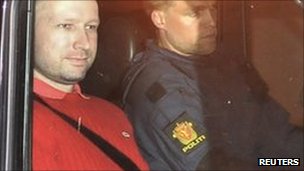
Anders Brevik (L), arrested for the Norwegian bombing and shootings, wearing a Lacoste shirt>P>
Reports suggest that Lacoste has contacted Norwegian police and asked them to stop Brevik wearing the Lacoste brand. It isn’t clear to Brandjack News how the police would do that, other than by requiring Brevik to wear prison clothes, which would be concerning in itself. If forcing the accused to wear prison clothing is not the norm in Norway, then it could be thought to prejudice Brevik’s right to a fair trial. (Granted, Brevik seems not to be disputing the facts, so it may be that a trial is not necessary, but this cannot be presumed). We probably also ought to ask why the police would do this as a favour to Lacoste.
The BBC also suggests that Abercrombie and Fitch has offered to pay the cast of an MTV reality show not to wear their brand. This also seems to pose problems for a brand, offering the possibility of non-aspirational celebrities deliberately associating themselves with brands in order to be paid to desist from this activity. -
By Quentin Langley
While trying to limit this blog to the specifics of the current case, some comment on general principles seems relevant. It would be unfortunate if people who do awful things never got a second chance. With the exception of criminals sentenced either to death or life imprisonment, even criminals are released from prison. It would sad, not only for them, but for people at large, if those released prisoners never got the chance to be employed in legal work. That would make it hard for them to reform themselves.
Galliano has not been sentenced to prison, but only to a token fine. In countries with a strong tradition of free speech, such as the US, even this seems terrible. He only said things. He was not guilty of violence or theft. But, let us put that aside. Whether or not the disgraceful things he said should be criminal, there is no doubt that they disgusted large numbers of people and Dior was well within its rights – and undoubtedly wise – to fire him. This is not, of course, because people with anti-semitic views inherently lack talent as clothes designers. Those with more interest in the subject than I seem to take the view that he has considerable talent. It is because he is a very high profile designer, and people were attracted to the Dior brand not just by the quality of the designs but by their association with John Galliano's name. People are no longer so attracted to his name, whatever they think of his talent.
To exclude him from employment in high profile roles, therefore, is the equivalent of keeping a fraudster away from roles involving money. His name used to be an asset with a positive value. Now it has a negative value. If he wishes to design clothes, he may have to do so anonymously for a while. No fashion house is likely to declare that they are carrying Galliano designs. While this might not seem to be a problem – after all, most designers are anonymous, with only a small elite having public followings – any fashion house that employed him in such a way would be accused of hiding the fact that they were employing him, and that would damage their reputation. He may really have to start at the bottom, submitting design ideas to brands anonymously, so even his employer doesn't know it is he.
It might be better for him to pursue a completely different career for a while. Perhaps a comparison should be drawn with the British politician, fraudster and spy, John Stonehouse. With his business interests failing, Stonehouse faked his own death and fled to Australia, but was eventually caught and served a prison sentence for fraud. (Allegations that he was a spy for Czechoslovakia were only confirmed after his death). On his release, Stonehouse dedicated himself to fundraising for charities. Only after some years success in this field did he become a novelist and begin to make TV appearance again – mostly discussing his failed attempt to fake his death.
If Galliano wants to earn forgiveness for the horrible things he said, he should devote his time to helping others for a while, recognising that people don't want to be seen wearing his designs at the moment. In his case, since he claims his anti-semitic rant was brought on by alcohol and drug abuse, he needs to spend time helping people with addctions. When he has proved that he has both overcome his own addiction and been a successful counsellor to other addicts, people may look again at his work in the fashion sector. Until then, anonymous hard work helping others would be his best approach.
-
By Quentin Langley
 Brandjack News