• By Quentin Langley

    Art Uncut is one of those organisations which, when it organises a "tax protest" is not complaining that the overall level of taxation is too high, but that some people – not them, of course, some other people – should be paying higher taxes. Mostly, it is rather unseemly. No-one has an obligation to organise their financial affairs in such a way as to maximise tax liability, and anyone who wants the government to have more money is perfectly at liberty to send some to it.

    But when the target is U2 and Bono, they have a point.

    Bono, after all, is a big believer in taxes.Though, it seems, he too mostly believes in other people's taxes. Bono wants me to send more money to the developing world. Nice of him. He has no idea how much I send now, but that's okay, he still thinks it should be more.

    Not that I am against sending money to help people in distress. I buy goats for families in Africa and sponsor a girl – Reeta Kumari – in India, but I don't like taking lectures on the issue from Bono. As I understand it – and if Bono is reading this, and I am wrong, I will be happy to withdraw – when Bono flies he buys a first class seat for himself and another for his hat. Now, I get that, I really do. The hat may well be part of his branding – part of his act – and important to his business. But, as long as his hat has a higher standard of living than I do, I don't see why I should take lectures from him about the number of goats I buy and the number of girls I sponsor. I could do more. We all could. But I couldn't do as much more as Bono could, especially if he is taking extra special effort to minimise his tax liability.

    Unless, of course, all the money he manages to avoid in tax gets sent straight to children in Africa. Then, maybe, we could look at this a little differently.


  • By Quentin Langley


    The Week in Brandjacking report from Quentin Langley, including thoughts on gay marriage in New York, the resignation of FIFA VP Jack Warner, and Greenpeace’s approaching victory over Mattel in the Ken & Barbie brandjack.


  • By Quentin Langley


    As predicted by Branjack News on Twitter, Mattel seems to have surrendered to the Greenpeace Ken and Barbie brandjack.


    It isn’t over yet. So far, Mattel has frozen its contracts with controversial pulp and paper company, APP. Presumably, this is a step on the way to cancelling its contracts and signing up to a Greenpeace-endorsed code of practice on sourcing pulp and paper products.


    When that issue is settled, Ken & Barbie will be free to get back together.


    More at PR Week US.

  • By Quentin Langley


    In the week that Jack Warner has resigned as a FIFA Vice-President, the excellent Ragan’s PR Daily reminded me of this classic in poor media relations skills. There is no doubt Panorama can be a bit provocative, but Warner really seems to be stretching the idea of positive relations with the media.


    Given that Warner had previously told the same reporter to “go fuck yourself”, is there any example of worse media relations skills short of actual violence to reporters?

  • By Quentin Langley


    Why should we vlog, rather than blog? Isn’t the written word a better way of presenting a logical argument?


  • By Quentin Langley

    As ever, Greenpeace backs its YouTube campaign with some photogenic stunts:


    “As long as I look good, who cares about tigers in some distant rainforest?”


    Another first rate brandjack from the guys in green.

  • The first video blog for Brandjack News, Quentin Langley reporting:


  • By Quentin Langley

    The story has been dragging on for three years now. BBC’s Panorama aired a documentary about the clothing retailer, Primark, alleging all sorts of unethical practices, including using child labour. As a result, the retailer fined some of its suppliers for breaching the contractually agreed guidelines, but also complained to the BBC about some allegations which it claimed were simply false.


    The BBC initially rejected Primark’s complaints, but Primark appealed to the BBC Trust, which has now found in the retailer’s favour on one key component. Primark alleged that one scene in the documentary had been faked and cited all sorts of inconsistencies in the scene, such as needles which were simply the wrong size for the delicate stitchwork shown. The BBC sent an investigator out to India and concluded, on the balance of probabilities, that the scene had probably been faked. The BBC conceded that it could not conclude malpractice by its reporters beyond reasonable doubt.


    This is where the Guardian’s media commentator and blogger, Roy Greenslade, comes in. Greenslade is horrified that the BBC should find against its journalist on the basis of probabilities. Is the journalist not entitled to a presumption of innocence? Should journalists not be protected by the standard of ‘beyond reasonable doubt’?


    At no point in his blog does Greenslade seem to consider that Primark might be entitled to a presumption of innocence. Primark’s customers, its shareholders (ie, pension funds for millions), and its staff were all severely damaged by a piece of ‘journalism’ which the BBC has concluded was probably faked. And this is okay with Roy Greenslade?


    When it comes down to it, Greenslade is asking the BBC to defend journalism which it has concluded is probably wrong. How is that fair to BBC’s viewers?

  • By Quentin Langley

    Not only was the author of the blog "A gay girl in Damascus" not gay, not a girl, and not in Damascus, but it turns out that "Paula Brooks" editor of the LezGetReal lesbian website, is also a man.

    "Paula Brooks" – really Bill Graber from Ohio – had a complex relationship with Amina Arraf – really Tom McMaster, an American student in Edinburgh. The pair had flirted heavily online. Each believed the other to be a gay woman at the time of their flirtation. When McMaster's hoax was exposed, "Paula Brooks" was one of the first to condemn him, before himself being exposed as a hoaxer.

    McMaster and Graber both claimed to be raising serious issues and, in a sense, they were. Discrimination against lesbians in the US is far from unknown, and the hoax abduction of "Amina Arraf" was wholly credible. They Syrian government is engaged in a vicious crackdown on regime critics, and prosecutes homosexuality as a crime even during its ordinary day to day tyranny.

    Just as oppression of gay people in Syria is much more widespread and more severe than in the US, the consequences of McMaster's hoax are much more serious than Graber's. McMaster faked the abduction of Amin, leading to an international campaign for her release. He claimed that Amin was born in Virginia, and had dual US-Syrian nationality. The State Department became involved, wasting consular time on entirely fictional story.

    McMaster claimed that his narrative was wholly credible, and served to highlight the real plight of gay people in Syria. It is true, of course, that people are hardwired to remember and respond to stories. A narrative surrounding an indvidual victim of oppression is easier to relate to than a mass of statistics about the numbers brutalised by the Assad regime.

    But McMaster's hoax is more damaging than the specifics of gay repression in Damascus. Almost the whole of the Arab world is held captive by brutal dictators. The last assessment by Freedom House rated Kuwait, Morocco and Lebanon as 'partly free' and every other Arab country as 'not free'. Right across the Arab world people are rising up against appalling regimes. Especially in Libya, Syria, Bahrain and Yemen, we depend on people to bear witness to repression. This bearing witness by digital activists helped depose the regimes in Egypt and Tunisia. 

    Dictators around the world are taking comfort from McMaster's exposure. Every time someone bears witness to their crimes, they will be able to respond that it is probably another fake.

    So where is the positive lesson in all this? Perhaps it is lies in the vision of Douglas Adams. In response to critics who pointed out that information on the internet is not checked and is therefore unreliable, Adams pointed out the absurdity of our assumption that anything in wiriting ought to be reliable. As Adams – ten years gone, but as prophetic as ever, put it:

    Of course you can’t ‘trust’ what people tell you on the web anymore than you can ‘trust’ what people tell you on megaphones, postcards or in restaurants. Working out the social politics of who you can trust and why is, quite literally, what a very large part of our brain has evolved to do. For some batty reason we turn off this natural scepticism when we see things in any medium which require a lot of work or resources to work in, or in which we can’t easily answer back – like newspapers, television or granite. Hence ‘carved in stone.’ What should concern us is not that we can’t take what we read on the internet on trust – of course you can’t, it’s just people talking – but that we ever got into the dangerous habit of believing what we read in the newspapers or saw on the TV – a mistake that no one who has met an actual journalist would ever make. One of the most important things you learn from the internet is that there is no ‘them’ out there. It’s just an awful lot of ‘us’.

    If there is a lesson in the McMaster and Graber hoaxes, it is this. It is time to turn our critical thinking faculties back on. We need them, and we were crazy to think we could manage without them.
  • By Quentin Langley

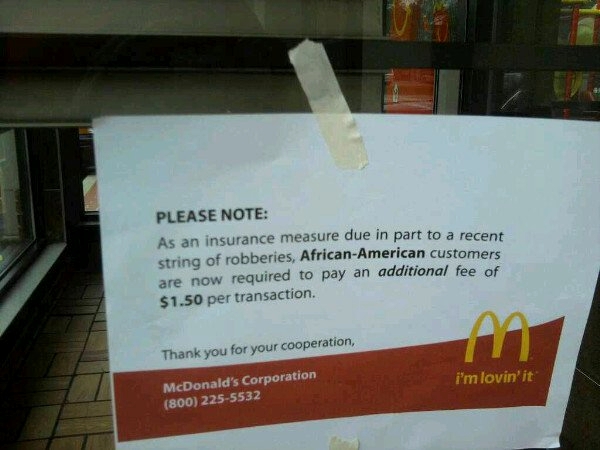
    McDonalds has long been one of the most recognised – and most controversial – brands in the world. From McLibel to Supersize Me, McDonalds has been on the receiving end of a great deal of criticism. As ever, there is merit on both sides of these debates. But now Big Mac finds itself as victim of a particularly nasty hoax.
    It should be stressed that, despite the story trending on Twitter for a while, the racist McDonalds story is a complete fake. But they do say that a picture is worth a thousand words.
    Seriously-McDonalds-racist
    NB, the image has been posted widely on the web and I am unable to track down any copyright information. If this is your image and you object to my using it, please let me know. Be aware that creating this image leaves you open to action for defamation in many jurisdictions.