• Writing about the brand of someone whose name is "Brand" opens the door to some possible confusion. Despite the name of this blog – and the title of my book – I have long been clear that I prefer the word "reputation" to the word "brand", since it connotes exactly the same to the lay audience as it does to academic and professional commentators. 

    Russell Brand is now being demonetized by some platforms – notably YouTube – and advertisers are individually boycotting his content on other platforms. They are doing so because he has been accused of sexual assault and rape over incidents some years ago, when he was still prominent in the mainstream media. 

    It is worth noting that he has not been convicted of any crime.

    It is also worth reminding ourselves why his career in the mainstream media was curtailed. He was suspended by the BBC over an incident in which he and another entertainer phoned the actor, Andrew Sachs, and left a lewd message on his voicemail. The message boasted that Brand had had sex with the actor's granddaughter. (This was actually something said by the other entertainer, who not worth naming in this context).

    The young woman has recently reconfirmed that the encounter did take place, and that it was consensual. Since the radio show of which this was a part was not live, but recorded, the BBC is open to considerable criticism for suspending the two presenters, when the corporation itself took the decision to broadcast the offensive material, knowing its content. 

    Legally, Brand is entitled to the presumption of innocence. He cannot be imprisoned without conviction in a court of law to the appropriate standard: beyond reasonable doubt. 

    Any person or business which wishes to avoid dealing with him is legally and morally allowed to do so. They can do so just because they think he is unpleasant: though that case seemed clear to me before these latest allegations. 

    YouTube, like the BBC before it, has put itself in a difficult position. It was happy to deal with Brand before these allegations but no longer is. That makes it pretty clear that it is these unproven allegations that have made the difference. So, what is its policy with regard to unproven allegations of criminal conduct? Are these just judgments it makes up as and when they arise? Is that an adequate policy for a generally open-access platform?

    YouTube is not the BBC. Its typical policy is to allow anyone to post material. The material is not edited by YouTube and carries no stamp of approval. That's a good strategy, and one it should probably maintain. Generally, content producers with strong followings can earn money from their content. Flat Earthers do, whereas Holocaust deniers are generally banned. 

    YouTube's own guidelines for monetization refer to the content, not the content provider.  You are advised to avoid such things as "inappropriate language" or violence. It doesn't say that the same content is acceptable from some content providers but not from someone the platform views as morally suspect. 

    Plainly, YouTube is in a difficult position. Some content is unlawful in some jurisdictions. Holocaust denial is illegal in much of continental Europe, for example, but the platform can't simply ban any content that is unlawful in some places. Criticizing the government of China is unlawful in China.  

    It seems a responsible principle that someone should not be able to cash in on crimes. If a person has been convicted of a crime, then creating content about that crime is something YouTube should not allow. But, even when convicted, should a person be forever denied access to making new content?

    The BBC is under no obligation to commission programs from Brand. Advertisers are under no obligation to support his content. But a blanket banning or demonetizing of his content by a generally open-access platform seems unwise.

    If YouTube had asked my advice, I would have said demonetize anything he says about the allegations themselves, but otherwise leave his channel alone. 

  • Should brands take stands on controversial topics?

    The first question is, why would you? It is inherent to the word “controversial” that you are going to irritate at least some people. Most of the time, customers who agree with you are not going to buy any extra product and some people will buy less or stop altogether, so it is likely to be a net damage to your business.

    Of course, sometimes you have to. I don’t mean, in this instance, that the moral case is imperative, though might be true sometimes. I simply mean that there is no alternative. For example, if you are a cosmetics brand, you either test on animals or you don’t. There’s not a way of avoiding the issue. If you have no policy on the issue, then are almost certainly using ingredients that were tested on animals. Do you provide healthcare and other benefits to the partners of your gay employees? Again, there simply has to be an answer to the question, though in the case of some, usually smaller, businesses, it may not have arisen. Such questions are inherent to your business operations.

    But putting out a statement of your views on, say, abortion, if you are not in the business of providing gynecological services or pharmaceuticals, is necessarily optional. And exercising that option will alienate a portion of your publics. Taking a stand on issues that are outside the scope of your business operations is a risky strategy, and is more likely to hurt your business than to help it.

    Let’s hone in, for the moment, on customers, though there’s a case for saying that longer term stakeholders such as staff or investors may be more motivated by these issues.

    Are your customers typical of the general population? Starbucks was vocal about providing gay partner benefits back when gay marriage was much more contentious than it is today. The concept had been rejected even in liberal states such as Washington and California (twice). But as a hip, urban, brand, the company may have concluded that its customers were generally more liberal than the US as a whole. Disney had, much more quietly, been providing gay partner benefits for much longer. Its customers are mostly families with young children. It probably did so because customers don’t care much about staff benefits whereas staff do, and it was recruiting singers, actors, dancers, almost all of whom probably had gay friends, even if they were not gay themselves.

    Disney is also different from many businesses because its assets include some compelling IP. Many children really want to go to its parks and consume its products. Those products simply aren’t available from a competitor, and parents might have been very uncomfortable explaining to children why they wanted to boycott Disney.

    Why would Bud Light decide to use a prominent trans influencer? They were presumably aware that this would be contentious with a significant segment of their customer base. My guess is they were trying to appeal to new customers. If so, it seems to have backfired, with significant boycotts by existing customers.

    Trying to appeal to new customers under the same brand name always runs the risk that you will reduce your appeal to existing customers without attracting many new ones. Complete repositioning strategies are hard to pull off.

    So, here’s a list of questions brands considering tackling a controversial issue should consider:

    1. Do you have to? Is there a way you could simply not be involved in the matter?
    2. Is this going to alienate a significant public?
    3. Is it something that really matters to a stakeholder group? This doesn’t mean just that the issue matters. Does it matter to them that you should take a stand on it?
    4. Are your publics – customers, staff, investors, etc. – in line with the general public on this issue, or they likely to be outliers?
    5. How competitive is your market? Can people who disagree with you easily replace your product with something similar.

    On the whole, I would say there has to be a compelling reason to take a stand. Otherwise, don’t.

  • After a hiatus, Brandjack News is once again covering brandjacking, ESG, crisis, business ethics, and digital communications. 

  • By Quentin Langley

    According to Google Trends, searches for some variation of "corona beer virus" have increased dramatically in recent weeks. But does that mean that people are confusing the beer and the virus. 

    First, the confession. I am one of those searchers. Obviously, there are few people who write professionally about crisis management, and particularly the social media aspects of crisis, as I do. But my example demonstrates one of the weaknesses of Google Trends as a guide to what people are thinking. The fact that someone has searched doesn't tell you why the person did that search. 

    Significant numbers of people are undoubtedly searching in order to find amusing content about how stupid other people are, and in doing so contributing to the number of people who participated in the 'dumb' search on Google. 

    Furthermore, the beer brand has been deliberately contributing to the profile of this "confusion" by creating its own amusing content on the topic. You can be sure the brand would not be doing this if it was losing sales from people who feared catching the virus. 

    Image may contain: text

    The makers of Corona beer have also mooted the idea of starting a fund to have the virus renamed "budlightvirus"

    Google has a pretty good idea the general topics people are discussing, but the brand owner has much better information on whether or not this is changing anyone's behavior. It seems it isn't, and the beer is earning kudos from its willingness to participate in these discussions with good humor. 


  • By Quentin Langley

    At a restaurant you might order the Tuscan Pizza with no onions but with extra black olives. Alternatively, the whole menu might be a la carte, and you build your own pizza or salad. Either way, some sort of negotiation has happened between the customer and the restaurant over what, exactly, is going to be delivered, and while both bear responsibility for the result, the customer is the one ordering. We all understand the process. 

    If you are buying a car, however, the negotiation may not be equal. A car manufacturer would not usually make key safety features optional, but if it did – passenger airbags, for example – it would be transparent about it. The manufacturer will not make engine parts a la carte, because customers won't necessarily understand the significance of them or know which are essential to the operation of the car.

    Purchasing aircraft is even more complex. But, in some ways, it has more in common with buying a pizza than buying a car. There isn't, or shouldn't be, the imbalance of information. An airline will have buyers who are just as expert in air safety as the manufacturer's sellers. But that only works if the manufacturer is transparent. 

    Brandjack News was not in the forefront of the first wave of commentators criticizing Boeing over recent crashes. It seems a little odd to offer an aircraft for sale without key safety features, which you then sell at a premium price. But how different is this from agreeing to sell an aircraft without those features at the request of the customer? Trying to fit either of these scenarios into a restaurant model is a fool's errand. The negotiations involve teams of experts, probably over some years, agreeing the specifications. Both sides are intimately involved but, ultimately, it is the customer who decides whether safety is important enough to be included in the order. If the manufacturer was being transparent. 

    But, it seems as if matters were even more complex than I assumed. The Wall Street Journal has reported:

    Plane maker Boeing Co. didn’t tell Southwest Airlines Co.when the carrier began flying 737 MAX jets in 2017 that a standard safety feature, found on earlier models and designed to warn pilots about malfunctioning sensors, had been deactivated.

    So, you can opt to have some new safety features excluded, but if you do, some existing features, which are actually installed in the plane, will be deactivated. 

    At present, it is not actually clear why this was even done. If, as the report suggests, it was done without telling Southwest, it cannot have been as part of pressure to get them to buy the additional features. More likely, the existing sensors interact with the new features, and were deactivated because the new features aren't present. 

    If anyone at Southwest knew about this deactivation, the information certainly didn't get to the people who actually needed it. Southwest's manuals for pilots were wrong, telling them that sensors would warn them of a problem when the sensors in question were turned off. 

    A separate report in the Journal tells of how investigators have now received information from several whistle-blowers at Boeing. 

    It is not yet clear what these whistle-blowers are saying about blame, but things are beginning to look very bad indeed for one of the most storied names in aviation. 

  • By Quentin Langley

    While Starbucks feels rather ubiquitous, it is a predominantly urban chain. Its clientele skew younger than average. The company makes a lot of its environmental and fair trade commitments . Founder, Howard Schultz, used to talk about the "third space" – somewhere that was neither home nor office. The focus on liberal values probably allows customers to feel more comfortable there. It is not Whole Foods, but its customers are likely to skew to the liberal side of the bell curve. 

    But, of course, Starbucks is a huge global business. Mr Schultz, no longer running the company, is a billionaire. A lifelong Democrat, he feels his party has left him. Still committed to liberal values, he is not happy at the Party's tilt on the economy. He also fears that by choosing a left-leaning candidate the party risks losing again and, worse, losing to Donald Trump. 

    So, Howard Schultz is thinking of making an independent run for President. It seems likely that he would stake out a middle-ground based on liberal social values while not demonizing business and wealth. In general, that's a position which polls fairly well, but would be unlikely to succeed in the Democratic primaries and even less likely to succeed among Republicans. 

    The risk, for Starbucks, is that the company's high profile founder could be a complicating factor for any Democrat running for President. What if Schultz undercuts the Democratic vote and helps Donald Trump to re-election? That won't play well with a significant number of Starbucks customers. 

    The management of the company could not distance itself from Schultz if it wanted to. He remains a significant shareholder and his name is intimately connected with the brand. But it cannot afford to embrace him either, if people see him as denying the Democrats a chance at unseating the President. 

    Polling from Michigan by Emerson Polling suggests that Schultz would draw voters fairly evenly from both sides, but it is very early days. We don't yet know the identity of the Democratic candidate. If the party chooses someone that the public sees has being outside the mainstream, Schultz could pick up more votes from the Democratic side. And then there is the desire to have someone to blame. If Schultz were to pick up support evenly from both sides and Trump were to win, Democrats would want to believe that it was the fault of Mr Schultz, because the alternative would be admitting that they lost to Donald Trump in a fair fight, and that's emotionally tough. 

    So, there's a fair chance people will be blaming Schultz for risking, and then, perhaps, producing, a Trump victory. And that is a risk that Starbucks is going to have to manage. Something which taints the company's brand with liberals could be very damaging. 


  • By Quentin Langley

    Let us consider two people.

    The first is a comedian and activist. She is Jewish and was born in the state where Donald Trump saw his biggest fall in support compared with Romney or McCain. She was a vocal supporter of "Occupy" and sought the Green Party's nomination for President in 2012. She ended up running for the Peace & Freedom Party with Cindy Sheehan as her running mate. She attacked Green Party candidate, Jill Stein, from the left, suggesting Stein was transphobic. 

    The second is a stay-at-home mom in a blue collar family living a small town in the Midwestern rustbelt. She's lived in the same town all her life.

    Which of these two women would you suppose would be a more natural Donald Trump supporter?

    It's not even close, of course. Trump's campaign was focused very heavily on small towns in the Midwest, and especially blue collar voters in those towns. Many of those voters felt left behind by economic and social changes and Trump argued that he, unlike professional politicians, was not going to neglect them. 

    The first of these women is Roseanne Barr. The second is Roseanne Conner, the fictional character Barr played in her eponymous sitcom. 

    What turned Barr from an Occupy supporter into a Trump supporter? Well, in some ways, the transformation was not that big. Bernie Sanders advocated protectionism because he too claimed that blue collar voters had been left behind. He wasn't wrong about that, and nor was Trump. Whether either of them had viable solutions for the problem is a question for another day. 

    But Barr advocated reeducation camps and beheading for Wall Street bankers with over $100 million. Doesn't that make her an unlikely supporter of a billionaire property developer?

    Maybe Barr's recent conversion to Trumpery is all branding. Maybe she missed the gravy train of her hugely successful sitcom and wanted to bring it back. To that end, she started tweeting not her own views, but began tweeting in character as Roseanne Conner as part of a campaign to revive the series . 

    If so, it worked. But it worked so well that the character's tweets became ever more outrageous until Disney, parent company of ABC, pulled the plug. 


  • By Quentin Langley 

    It has been a week since Southwest Airlines lost a passenger in a most dramatic fashion: Jennifer Riordan was literally sucked out of a plane mid-flight. 

    Looking back at this incident we see all the features of Twenty First Century crisis:

    The key one is live vlogging. As other airlines have discovered, you have to assume that someone is recording every customer incident. More recently, Starbucks has discovered the same thing. The barrier between public and private space has disappeared. In this incident, the events were being broadcast live on Facebook. Other passengers on the plane could actually have been viewing what passenger was broadcasting. Had the plane come down, passengers could have broadcast their own deaths. 


    This changes the way the wider public views the developing crisis in breathtaking ways. 

    Social media – especially video platforms such as YouTube and Facebook Live – are revolutionary technologies. They put into the hands of virtually everyone, technology that was carefully licensed and controlled by governments just a few years ago. 

    But they also give participants in the crisis – such as Southwest CEO Gary Kelly – the opportunity to respond immediately. 


    As recently as the 1990s, your editor was involved in a business crisis in which a TV documentary grossly distorted what a spokesman for the company said. We had the video to prove it. If this had taken place after 2005, we could have posted the video on YouTube and exposed the documentary makers as frauds. 

    Kelly's performance in this video is professional. He doesn't have the natural flair of a Richard Branson. He cannot visibly emote the way Branson does. There would have been a catch in Branson's voice and tears in his eyes. He would have name checked Jennifer Riordan, and her closest family. 

    Sure, I realize that the first response may not have been able to name check Riordan, because the name may not have been public at that point, but Branson would have followed up when it was. He would also have been on the scene within hours. But not everyone is Richard Branson. It is not a reasonable expectation of most CEOs. 

    The rest of Southwest's response was equally professional. A team was sent to liaise with the family and make travel arrangements for them. Grieving families have a deep personal need to visit the site of the tragedy – or as near as they can get – and airlines have the infrastructure to make that happen. 

    This is a textbook case study. Students will be reviewing the handling of this for years. 


  • By Quentin Langley

    Most of the time, people recognize advertising. When I am discussing marketing or public relations with students new to the topic, we normally start by using advertising as a point of reference. If you work in PR or marketing then perhaps you have an elderly relative who is convinced that you are "something to do with advertising". 

    Advertising, after all, is the thing that interrupts us when we are doing what we really want to do. It interrupts the TV or radio show we are enjoying, or maybe the newspaper or magazine. It is a clearly identified paid message. 

    The idea that we might be exposed to advertising messages without realizing it is scary. When James Vicary announced in 1957 that by including messages about Coke and popcorn on a single frame in a movie reel – ie, for one twenty fourth of a second – he had boosted sales of the products, people were scared. Including these "subliminal" messages, which the brain doesn't register, is illegal in Britain as a result of Vicary's experiment.

    Of course, the movie theater announced that there had been no boost in sales and Vicary admitted his research was premature. Others have suggested it was simply a hoax. 

    The British satirical show "Spitting Image" used subliminal messaging to suggest the script writers were extremely skilled lovers and you should "sleep with one today". Norris McWhirter of The Freedom Association lodged a complaint about this and the show responded by including a montage – what we would now call a photoshop – image of McWhirter in an unflattering sexual pose. The show was consciously, and harmlessly, breaking the law. 

    The ideas of hypnotism, voodoo, and subliminal advertising are all linked in that they play on deep human fears: that we are being manipulated. 

    The Cambridge Analytica story does the same. Yes, this blog is already on the record as saying that Mark Zuckerberg should have been much quicker to take control of the story. But that doesn't mean the story itself is very interesting. 

    Cambridge Analytica's overhyped services were just about targeting messages. People have been doing this for years. In 2004, the Guardian encouraged its British readers to write to voters in Ohio because it, correctly, anticipated that this would be the key state. The Obama campaign in 2012 extracted Facebook data to target messages to people in swing states. The media thought this was an example of Obama's brilliance and demonstrated how social media would democratize the world. 

    But in 2016 it was the Trump campaign that was better at targeting. Not, in this writer's view, because of Cambridge Analytica or the Russians, but because Hillary Clinton made a huge strategic mistake. She thought she was sure to win the Electoral College but was in danger of losing the popular vote. She concentrated her efforts on solidly Democratic states such as California, New York and Massachusetts to push up her vote. She succeeded. But the Trump campaign had developed messages that were carefully crafted for blue collar voters in the rust belt. That's where the election was actually decided and so he won. Nothing spooky or magical about it. 

    Did the Trump campaign pay Cambridge Analytica for its services? Sure. In my view they almost certainly overpaid. Did they collude with the Russians? Possibly. Let's see what evidence emerges. But the facile images that circulated on Facebook had no influence on the election result.

    Fears about manipulation using social media data are deeply felt but also deeply misplaced. It is just a matter of focusing messages on the swing states. Trump, Obama, Bush and Bill Clinton all did that effectively. That's why they won. 


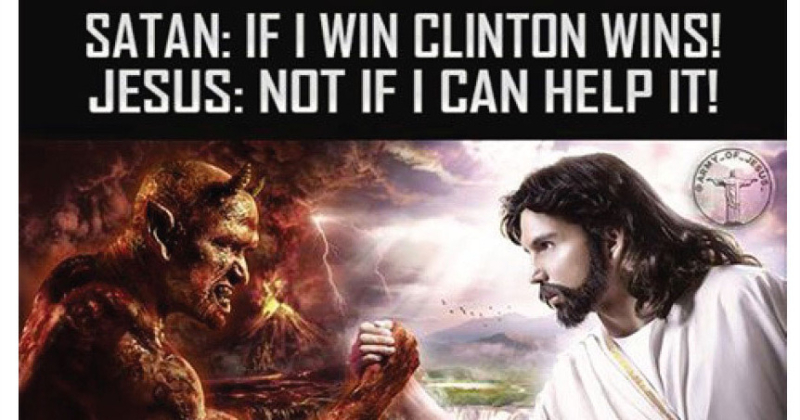
    Does anyone seriously think that images such as this won over any Clinton voters?

    Satan clinton

  • By Quentin Langley

    The 2015 movie Steve Jobs grossed $34 million, won two Golden Globes and was nominated for two Oscars. It is unusual for critically acclaimed movies to feature real business people – or even fictional ones – in a positive light, but even this movie fell far short of 2010’s The Social Network which grossed $225 million and was nominated for eight Academy Awards, winning three of them.

    I am not seeking to demonstrate the Mark Zuckerberg is a better businessman than Steve Jobs, but this is one indicator among many that Zuckerberg is an extraordinarily high profile business leader. Observers of Silicon Valley also say that he keeps a tighter grip on his company than most of the tech titans too.

    So where is he?

    Apparently he is to break his silence on the Cambridge Analytica story today, but it has been a long time coming.

    The first rule of crisis management is to be the source of your own story. Be the person who is driving the agenda. At the time of writing, Zuckerberg has not spoken to the media or to Facebook staff.

    That’s a significant leadership failure for a CEO of his stature. He needs to be at the front of this story. Now.