• By Quentin Langley


    Twitter and other social media are, of course, alive with conversations about Naomi Campbell, and the supermodel is hardly emerging with any distinction. Most of the comments are mocking or hostile, and often on a puerile level. Most assume she is a villain, though it is far from clear from her testimony that she is anything of the sort. Most assume she has done a great deal of damage to her reputation, and in this they are surely right.


    Whatever Ms Campbell did or did not know about the ‘dirty stones’ given to her in the middle of the night while she was a guest of Nelson Mandela’s, it seems unlikely she will ever again be the guest of any revered head of state. And she did this to herself with a single remark, that giving evidence to a war crimes tribunal was “an inconvenience” to her.


    Click here to continue reading this post.

  • By Quentin Langley


    Twitter and other social media are, of course, alive with conversations about Naomi Campbell, and the supermodel is hardly emerging with any distinction. Most of the comments are mocking or hostile, and often on a puerile level. Most assume she is a villain, though it is far from clear from her testimony that she is anything of the sort. Most assume she has done a great deal of damage to her reputation, and in this they are surely right.


    Whatever Ms Campbell did or did not know about the ‘dirty stones’ given to her in the middle of the night while she was a guest of Nelson Mandela’s, it seems unlikely she will ever again be the guest of any revered head of state. And she did this to herself with a single remark, that giving evidence to a war crimes tribunal was “an inconvenience” to her.


    She also advanced other, more reasonable, arguments. Having read of the things of which Charles Taylor stands accused – mass murder, kidnapping and cannibalism are all on the list – she fears for her own safety and that of her family. Fair enough. But war crimes tribunals are reserved for pretty horrific allegations. Getting to the bottom of them, and holding the guilty to account, is rather more important than Naomi Campbell’s modelling career, even granting that she may do a great deal for important charities. Will charities still wish to be associated with Ms Campbell now that she has expressed the view that getting to the bottom of allegations about child murder inconveniences her?


    But if Campbell has damaged her reputation, what does this say about the role of the global mainstream media? This is the only sustained as live (with a thirty minute delay) coverage we have ever seen of trials in The Hague. Dramatic moments from the Milosevic trial were on the news, but not with anything like this level of coverage.


    Campbell’s testimony did not even get to the heart of the serious issues here. She could not (or at least did not) testify from her own knowledge that the ‘dirty stones’ she received a) were diamonds or b) came from Charles Taylor. Her testimony took us no closer to the key question of the trial – whether or not Taylor is actually guilty of the horrific crimes with which he is charged. And yet this is the news – the only news – that is worth reporting from The Hague.


    Rape, murder, cannibalism and genocide may be serious allegations. But to the mainstream media, they matter less than the fact that Naomi Campbell looks good on the catwalk.

  • When BP was gearing up to announce one of the biggest quarterly losses in corporate history, some attention was no doubt given to the question of how to move the news on.  Losses on this scale were never going to be buried completely, but to put some other news alongside them was, no doubt, a key part of the strategy.

    So, alongside the announcement of the losses came the much anticipated news that CEO, Tony Hayward, was leaving by 'mutual agreement'.  Plans for asset sales that would allow the business to handle its, still uncertain, liabilities from the Deepwater Horizon were also announced.  As a staunch critic of BP's PR so far, I have to concede that this was done rather well.

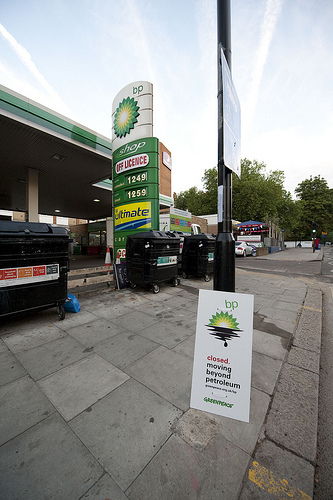
    The problem, of course, was Greenpeace.  The environmental group wanted to share the story, and has done so rather effectively.  They shut down BP service stations right across London.  In part they did it by tripping, and then taking, the forecourt safety switches.  But this is Greenpeace, so they wanted some visuals too.  Typically, this was the cleverest part of their campaign, as they hung signs on the forecourts declaring 'Closed: Moving Beyond Petroleum'.

    Moving beyond petroleum

    Copyright (c) Combermorel/Greenpeace
     

  • By Paul Garrett

    That the BP Gulf of Mexico oil spill is an environmental disaster is not in dispute. But the root cause of it and the political fallout – as Prime Minister David Cameron heads to Washington for a summit with President Obama, is worthy of analysis.

    Issue one – in an increasingly low carbon orientated world, the US is still addicted to oil. That is why it is betting the farm on importing tar sands from Canada and deep water drilling in the Gulf of Mexico – both strategies which carry a huge environmental premium.

    Issue two – drilling in the US requires a US partner – hence ‘British Petroleum’, as President Obama insists on calling it, needed US sub-contractors, including Halliburton, who were actually the hands on managers of the Gulf rigs.

     Click here to continue reading this post

  • By Paul Garrett


    That the BP Gulf of Mexico oil spill is an environmental disaster is not in dispute. But the root cause of it and the political fallout – as Prime Minister David Cameron heads to Washington for a summit with President Obama, is worthy of analysis.


    Issue one – in an increasingly low carbon orientated world, the US is still addicted to oil. That is why it is betting the farm on importing tar sands from Canada and deep water drilling in the Gulf of Mexico – both strategies which carry a huge environmental premium.


    Issue two – drilling in the US requires a US partner – hence ‘British Petroleum’, as President Obama insists on calling it, needed US sub-contractors, including Halliburton, who were actually the hands on managers of the Gulf rigs.


    Issue three – all outsourcing deals have as part of their fatal flaw the need to cut costs. Cutting costs means that safety margins can be compromised.


    So to the fall guy – Tony Hayward. Conveniently, from the US media’s point of view, a Brit . And as far from the Dallas J R Ewing swaggering oil man as you could imagine.


    A soft-spoken, intelligent geologist, he is certainly no PR man. Saying ‘I want my life back’ after eleven of his contractors lost their lives when the Gulf rig exploded will go down as one of the greatest PR gaffes of all time along with Mr ‘my products are crap’ Ratner.


    Hayward also has other facets you might not expect from an ‘oil man’. He believes, for example that markets cannot always deliver energy policy and that sometimes government intervention is required. That is not only ‘man bites dog’ in the world of oil, but intelligent too given that markets have proved themselves to be flawed in a number of ways since 2008.


    That Hayward will be sacrificed along with his chairman as the Gulf leak is finally capped is beyond doubt. That he will be handsomely compensated is also clear. But the real casualty will be BP as an independent entity. Obama will facilitate a takeover of Britain’s biggest company by an American oil major, probably ExxonMobil. David Cameron in Washington this week will be unable to stop this.


    The implications for thousands of UK pensioners reliant on a viable and independent BP ? Who knows?


    But ultimately UK Plc will be the loser – not just the shrimp fishermen of Louisiana.


    Now BP’s woes are piling up at the highest possible level. At the first Washington Summit between US President Barack Obama and British Coalition Prime Minister David Cameron, BP, by all accounts was number one and two on the list of issues the Americans wanted to raise.


    The Gulf of Mexico oil spill was unsurprisingly brought up, and Cameron pledged that BP would do the right thing in terms of covering the cost of the spill (although since it is a private company that is somewhat beyond his gift).


    But Cameron was put under pressure from Obama, and later a group of Senators , over the premature release of the Lockerbie bomber Abdelbaset al-Megrahi a year ago to his native Libya. This was done on humanitarian grounds by the Scottish Government, so was technically beyond Cameron’s jurisdiction and not on his watch.


    But crucially, BP was lobbying  at the time of Megrahi’s release last year for  a ‘prisoner exchange’ rapprochement with Libya,  while also negotiating for £550 million of Libyan offshore oil exploration rights.


    The Americans smell a rat. Cameron says the decision to release the Lockerbie bomber was wrong, and sees no need for an inquiry after the event, but this latest development puts BP on the ropes. Rarely has a company been linked, albeit unproven, with the release of a convicted terrorist.


    This story is not over yet. Meanwhile  the many people whose pensions are dependent on a healthy BP share price should be very worried indeed.


    Paul Garrett is a journalist, commentator and analyst who has been covering the European energy and water sectors for the past thirty years. After managing the UK water industry trade association’s press office during privatisation, he launched and then edited Utility Week magazine for ten years, then worked in a utilities advisory capacity for international consultancy Accenture for four years. He now contributes to a number of sector magazines.
  • Quentin Langley is Editor of Brandjack News.


    Quentin has a long track record in PR practice and scholarship.  In particular he has worked at the cutting edge of media relations, public affairs, crisis management and digital PR.  He now lectures widely in public relations including as a member of the faculty at the University of Bedfordshire Business School, where he is a Senior Lecturer in Marketing.


    Quentin is a former elected Council Member of CIPR, and a former Chair of CIPR International. He is also a CIPR Accredited PR Practitioner.


    An active member of PRSA and presently serving on the Global Affairs Committee Quentin is also a former International Delegate at Large. 


    A Fellow of the Higher Education Academy, Quentin works at the intersection of PR practice and the Academy, running practical workshops on digital PR and on public affairs for CIPR and other training providers.


    The first time he heard the word ‘brandjack’ was in a presentation at the PRSA’s Digital Impact Conference by Jeremiah Owyang, who was referrring to way Greenpeace dominated the social media conversation around Nestlé’s KitKat brand.


    You can contact Quentin Langley on editor@quentinlangley.net

  • Quentin Langley is Editor of Brandjack News.


    Quentin has a long track record in PR practice and scholarship.  In particular he has worked at the cutting edge of media relations, public affairs, crisis management and digital PR.  He now lectures widely in public relations including as a member of the faculty at the University of Bedfordshire Business School, where he is a Senior Lecturer in Marketing.


    Quentin is a former elected Council Member of CIPR, and a former Chair of CIPR International. He is also a CIPR Accredited PR Practitioner.


    An active member of PRSA and presently serving on the Global Affairs Committee Quentin is also a former International Delegate at Large. 


    A Fellow of the Higher Education Academy, Quentin works at the intersection of PR practice and the Academy, running practical workshops on digital PR and on public affairs for CIPR and other training providers.


    The first time he heard the word ‘brandjack’ was in a presentation at the PRSA’s Digital Impact Conference by Jeremiah Owyang, who was referrring to way Greenpeace dominated the social media conversation around Nestlé’s KitKat brand.


    You can contact Quentin Langley on editor@quentinlangley.net

  • By Quentin Langley


    The problem is this: if you have thousands of critics and you are just a single organisation, how can you engage? How can an overstretched PR department monitor and keep up with the social media conversations taking place all over the world?


    And if Jeff Jarvis is right, that there is an inverse relationship between control and trust, where does that leave the role of PR planning? The traditional PR plan, with its key messages and clear discipline is precisely what people engaged in social media will no longer trust.


    The first thing to say is that engagement in social media is still, very much, a PR function, not a sales, marketing or advertising function. If you are aggressively engaged in sales, you will soon be blocked or hidden from people’s feeds. That is not why people engage in social media. It is all about two-way interaction. It is about conversation. An advert is, by its nature, a one-way phenomenon. This is all about the management of reputation. This is where PR has always been: using media relations and sacrificing control for credibility.


    Continue reading this post

  • By Quentin Langley


    The problem is this: if you have thousands of critics and you are just a single organisation, how can you engage?  How can an overstretched PR department monitor and keep up with the social media conversations taking place all over the world?


    And if Jeff Jarvis is right, that there is an inverse relationship between control and trust, where does that leave the role of PR planning?  The traditional PR plan, with its key messages and clear discipline is precisely what people engaged in social media will no longer trust.


    The first thing to say is that engagement in social media is still, very much, a PR function, not a sales, marketing or advertising function.  If you are aggressively engaged in sales, you will soon be blocked or hidden from people’s feeds.  That is not why people engage in social media.  It is all about two-way interaction.  It is about conversation.  An advert is, by its nature, a one-way phenomenon.  This is all about the management of reputation.  This is where PR has always been:  using media relations and sacrificing control for credibility.


    But it remains the case that the disciplined management of messages won’t work.  You can’t evaluate social media in the way you evaluate media coverage in the dead tree and broadcast media.  You can read the FT and see if your messages were included in the editorial copy.  That is a mediated channel.  If your message is in, it persuaded the editor, and it carries that weight as a result.  It is precisely because you don’t control the medium that people find it credible.  On Twitter, of course you can always get your messages out, but will people believe them?


    There is only one way, and it is risky.  Only the best-run organisations can engage in this way.  It means relaxing control, but gaining credibility as a result.


    For example, what would happen if BP allowed all its staff, world-wide, to engage freely in social media conversations about the company?   And I mean freely.  If you ask 100,000 people to engage on Twitter, and then give them three key messages to deliver, you will be spotted as a spammer in a heartbeat.  You need to encourage your staff to engage honestly.  It is that honesty that will come over.


    BP_Logo_color


    Firstly, a great many people would be saying right now that they were embarrassed to be working for BP.  Good.  Admitting that is the first step to earning a right to be heard.  At very best, BP was the victim of an unlucky accident, and people are understandably embarrassed by the way it has turned out.  Some people would be critical of management decisions.  Some people may believe – and they may be right, I wouldn’t know – that the company unacceptably cut corners.  People would (legitimately) ridicule an environmental plan that tried to address the needs of Pacific sea life.  Others would no doubt chime in that they thought the company had done all it could reasonably be expected to do.  There would be a debate, and an honest debate about this would put BP in a better light than the current fiasco.


    Where  BP has been found  lacking is in honesty and engagement.  For example, Tony Hayward was asked, when giving evidence to Congress, if BP had been cutting corners on safety for the sake of cost, he said no.  This may be a very silly question, but it is also plainly not an honest answer.  BP weighed up the costs and the benefits of various safety measures.  There must have been additional safety measures they could have taken, but chose not to because of cost.  This is absolutely normal.  It is what all businesses, governments, charities, and individuals do.  It is what every driver does when deciding that it would be ludicrously expensive to get the brakes checked every morning.  To deny that BP made decisions on the basis of cost is utterly silly, and cannot be believed.


    After Shell experienced severe reputational crises in the 1990s it engaged in a strategy of ‘burden sharing’.  It held round-table discussions with a series of special publics – journalists, academics and campaigners – and engaged in genuine discussions with them about key problems.  Should a multi-national engage in a country with a brutal dictatorship?  Will boycotting such countries help or make things worse?  From the outside it can seem as though decisions are simple, and motivated purely by greed, but this is almost never the case.  Since Shell began its ‘burden sharing’ campaign, technology has plainly moved on.  Today any such campaign would be intimately linked to social media. 


    But the real challenge of the brandjacking world is this: if you are really prepared to trust your staff, and allow them to engage with others, then you need to first engage with your staff.  You cannot use your staff to parrot the corporate line, but nor can you leave them answering legitimate questions with “I dunno.  Nobody tells me anything”. 

  • By Quentin Langley


    When the American oil giant, Standard Oil, was broken up, one part of it, mostly based in the Mid West, became known as the American Oil Company, usually shortened to Amoco. Decades later it was one of the ‘seven sisters’ the big private sector oil companies that dominated the refining and marketing of oil and petroleum products. Along with Shell and BP from Europe and Exxon (Esso), Mobil, Texaco and Chevron from the US, Amoco was among the most well-known companies in the world. The very biggest oil companies, of course, are much more anonymous. The big exploration and production companies, like Saudi Aramco, the Kuwait National Oil Corporation and Nigerian National Petroleum Company remain government owned and avoid developing a consumer profile.


    Amoco-logo
    In the 1990s, the oil industry began to concentrate again. Exxon merged with Mobil, Texaco with Chevron and BP with Amoco. Only the very largest, already an Anglo-Dutch joint venture, avoided this and remained as Royal Dutch Shell. When BP merged with Amoco and absorbed the much smaller ARCO, the original plan was to brand all the American gas stations as Amoco with the BP name being used elsewhere. However, the BP name soon came to dominate. The name British Petroleum was dropped and the company name was officially changed to BP. The company began to use the slogan ‘beyond petroleum’.


    Continue reading this post