• By Quentin Langley

    It is often said that one way to filter whether a comment to a work colleague crosses line in terms of sexual innuendo is to ask yourself if you would say it in front of your romantic partner. Comments on Twitter should be subject to that filter, but also to whether or not you would say them in front of a client or customer.

    The reasoning is obvious: Twitter is a public space. You actually are saying these things in front of your partner and your clients. 

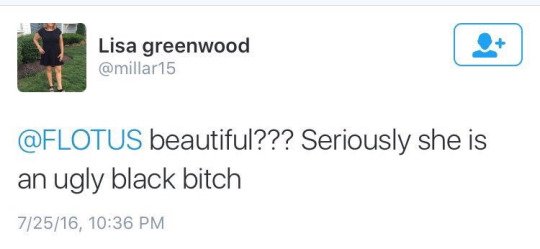
    Lisa Greenwood, then a loans officer with Home Point Financial, apparently didn't think this through:

    Greenwood


    Responses on Twitter were, as you can imagine, ferocious. Apparently, nothing in Greenwood's Twitter profile (since deleted) stated where she worked, but some judicious Googling and searching on Facebook located the information. Most of the tweets were fairly general, asking Home Point about its policy on employing racists. I am guessing the policy, at the time, was that the organisation didn't screen its employees for their political views. 

    But at least one activist went for the key issue. 

    With dez nuts (@ebony_eyez89) posting:

    @HomePointLoans you can't tell me someone who holds this view on the @FLOTUS is not abusing her powers on other minorities @millar15

    Once you can credibly link someone's controversial views to job performance, the employer needs to act. Other issues could possibly be weathered, but this one is critical.

    And just because other issues can be weathered, doesn't mean they should be. Ask yourself, if your views were gathering this sort of heat, why would your employer want to defend you?

    Home Point did not, and, within hours, announced that Greenwood "is no longer employed with Home Point Financial". Getting another job is not going to be easy. 

  • By Quentin Langley    

    This is an old story – thirteen years old – about long distance charges from MCI, a company which no longer exists, but it does show the power of the media. In this case it was the MSM – national radio in the US. It worked.

     This American Life

  • By Quentin Langley

    Whole Foods Market has been attacked in what seems to be one of the rare fake brandjacks. Pastor Jordan Brown released a video and picture of a cake he purchased at Whole Foods in Austin, TX, bearing the inscription "Love Wins", as per his order, and the word "Fag" which as he puts it "is not the cake I ordered". Brown is openly gay. This is a damaging. Whole Foods has a cult following in liberal, urban, areas even though, as was discussed in a case study in Brandjack, the founder and CEO is a libertarian, not a liberal. 

    Whole Foods has hit back hard. The company investigated quickly and claims the cake has been doctored. Its statement includes the claim that the bakery team member in question is a member of LGBTQ community and  a security video of Brown paying for his cake. Whole Foods says the video shows  the "UPC label" – the bar code – is on top of the box not on the side as it is in Brown's video. Certainly, you can clearly see the cashier scan the top of the box, not the side. Yet Brown shows it on the side, sealing the box, and uses this to argue that it's clear he hasn't opened the box.

    Other Twitter users have chimed in to support Whole Foods, making points about the handwriting and colouring of the writing to suggest that the word "Fag" was plainly added by someone else.

    Whole Foods is threatening legal action against both Brown and his attorney. This blog doesn't usually recommend legal action. It is often taken to close down a debate with which an organisation should engage. In this case, however, the company seems to be the victim of a completely faked attack. If that's right, then the attack is malicious, and not designed to make some wider point about the corporation's policy. In this case, legal action seems appropriate. 


    Update:

    Some four weeks after this post on Brandjack News the NY Times confirmed that, as speculated here, the story was a hoax.

  • By Quentin Langley

    Disney and its Marvel subsidiary are among the companies that have led calls for boycotts of Georgia – the US state, not the country in the Caucasus – if the religious freedom bill is signed into law by Governor Nathan Deal. The bill is aimed at protecting religious business owners from prosecution or law suits over declining service to gay customers, especially in relation to gay marriages.

    This matters. Georgia has invested a great deal in becoming an attractive environment for movie-making. Only California and New York are home to more movie-making. Marvel's hugely successful Avengers franchise has been filmed mostly in Georgia. There seems no doubt that Georgia will lose business as a result of this.

    This blog is not the right place to explore the balance between the rights of LGBT people and religious freedoms. This blog is for exploring the reputational implications for Georgia and the companies which choose to make a stand on this issue. 

    In my book, I mentioned more than once that I would generally advise companies not to take a stance on culture wars issues unless there's a good reason to do so. On the whole, people offended by the stance are more likely to shift their behaviour than people who support the stance. Most businesses would lose more customers than they would gain. If a corporation wants to sacrifice business by taking a principled stance, it should do so with eyes open.

    The interesting question to ask is, why does Disney want to take this stance? The corporation is not new to the issue. Disney is definitely not jumping on the bandwagon of an issue that has recently become popular. Disney has been offering "gay days" at its theme parks for 25 years. For 20 years it has offered its gay staff partner benefits. It publicly opposed the Defense of Marriage Act (DOMA). These were very controversial stances in the 1990s. DOMA was carried with overwhelming bi-partisan support in Congress. So why would Disney do it when it is reasonable to assume that, in the 1990s, most of its customers would have disagreed with the stance.

    We can make that statement with some degree of confidence about the 1990s, even though it is probably no longer true. Disney's core audience is families with young children – though the Marvel franchise appeals more to teens and adults. A majority in the US now favor gay marriage, and this is particularly true among younger people. But in the 1990s large majorities opposed the idea. Furthermore, gay people are not highly represented in a market segment that is dominated by families with children.

    The answer, I suspect, goes to the heart of a constant disagreement I have with those of my colleagues who teach marketing. They think PR is part of marketing. I think marketing is part of PR. Your marketing publics – customers and consumers – are important, but not the only publics a corporation needs in order to succeed. Disney also needs staff. Its talent base is critical to its success. It recruits talent from Hollywood and Broadway. Not every singer or dancer recruited from Broadway is gay and nor is every Hollywood actor, but you can guarantee that virtually all of them have gay friends.

    Sure, Disney got criticised in the 1990s by various church groups for its stand, but most customers really don't care that much about the staff benefits a corporation provides. Staff care. A lot. If Disney had continued excluding a significant section of its staff from critical benefits, those staff members and their friends would have found that offensive.

    Disney is protecting its publics. But how will Georgia fare if it proceeds with this legislation. Other movie-makers are likely to follow. Some high profile actors will take a stand, which will put pressure on other movie corporations to join the boycott. All that money invested in tax breaks could end up being wasted. 


    UPDATE: Governor Nathan Deal has vetoed the bill.

  • By Quentin Langley

    The Hill reports that supporters of Donald Trump are mounting a legal challenge to the campaign of Ted Cruz alleging that he is not a natural born citizen of the US, as required by the Constitution. Trump, of course, was a prominent supporter of the conspiracy theory that Barack Obama was born in Kenya and not in Hawaii as his birth certificate and the birth announcements of the Honolulu Star-Advertiser both show. 

    This seems an odd thing to do. There were twelve federal and numerous state actions regarding Barack Obama, and the majority were dismissed because the plaintiff lacked standing. Only one was referred to the Supreme Court, which refused to take it up without commenting on why. A few were dismissed because of lack of jurisdiction. Most, especially those made before Obama actually became president, were dismissed by the courts as frivolous. Attempts to manufacture standing after Obama became president were generally ruled as moot. 

    If it was not possible for people who had suffered no particular harm as a result of Obama seeking, and then being elected to, the presidency, to sue it is impossible to bring similar actions regarding Cruz. The plaintiffs would lack standing and the case would be dismissed. This is, of course, most particularly true during the campaign. The Constitution does not prohibit anyone – naturalized citizen or even non-citizen from campaigning for the presidency, only from being president. So any action while the campaign is still underway must necessarily fail. 

    So, why are supporters of Trump bringing the action against Cruz?

    One possible reason is that the court cases will gain publicity for the fatuous claim that there is a sliver of doubt about Cruz's eligibility. But I am not sure it is about Canada, his place of birth, at all. It is about Cuba. Even some well-informed people who follow the news quite closely are not aware that Senator Cruz goes by his middle name. His full name appears in the suit, which lists him as Rafael Edward Cruz.

    Perhaps the Trumpists are seeking to shore up Trump's support among nativists – probably a big slice of his constituency, which he doesn't want to lose to the Senator -by reminding them that Cruz has an Hispanic first name. They are trying to brandjack his campaign by getting people to call him Rafael.

    H/T to Gordon Landwirth for bringing this case to my attention.

  • By Adam Bissmire-Mullen

    Every once in a while something new comes out of the blue, buzzing with fresh life and unfounded promise, whilst typically coming off of the back of a viral campaign, press promotion or some form of similar genesis. Last week, we saw the emergence of a GIF friendly, iOS only, magic word instilled social network from the founder of popular video sharing app Vine, titled Peach. But is this new social network application as juicy as it sounds?


    How Does It Work?

    The application is currently exclusively available for free on the Apple iOS | iTunes App Store, although it will no doubt make its way over to Google’s Android platform in the near future due to popular demand (if it is indeed going to be popular). The app’s developers kindly left this short description on the App store, giving us a small insight into what it does: 


    'Share tiny updates as you go through your day. Posting is as easy as texting—with a twist. Some words are 'Magic Words' that give you quick access to fun and insightful things to share.

    On Peach, a little says a lot. Easily share pictures, looping photos, videos, and links, along with GIFs, the weather, your current location, what you're watching tonight, how many steps you walked today, and much more.'


    CNET’s Sarah Mitroff reports that “It's like if Facebook and Tumblr had a baby.” Think about the kind of typical post you see on Facebook – a picture of a morning cuppa, a friend checking in at a nearby restaurant etc. Peach pretty much emulates this same approach with the limitation that you cannot follow your favourite celebrities. Instead, you have to be friends with someone to view their personal posts. So Peach does indeed offer its end user something different: a truly enclosed social network, with the addition of an interactive flavouring.

    These interactive ‘magic words’ that the developers cite are indeed a quirky little feature, the brands unique selling point even. Magic words are similar to prompt commands, type in a word like ‘TV' for example and you will then be able to tag your favourite show from a respondent list; type ‘here’ and the app will then geo-location tag you at your current destination (a system akin to Facebook’s check-in feature). These quick access commands make the concept of micro blogging and status sharing all that more entertaining and accessible, but is it just another tech fad, waiting to rot away in decay… 


    Will It Remain Fresh?

    Peach currently has the tech world in a spin, with major news and media outlets having already reported on the application extensively. But this explosive flurry of news articles, blogs and video coverage will soon die out, leaving Peach to face the ultimate challenge – trying to survive in the ever-developing online world, a world that is flooded with trends and fads that die out as quickly as they are created…

    The Guardian's Alex Hern also highlights that “Peach is entirely contained within the app” itself – with “no way to view posts publicly.” This could prove troublesome, even worrying for a social application that is looking to extend its shelf life as far as possible. If posts cannot be embedded or shared via alternate networks and blogs, then the application may soon become redundant with its semi-permanent approach, forcing users to hit its hard stone centre once the initial, delicate flesh is consumed.

    So, the question is: will Peach survive, evolving into the next challenger to the Facebook Empire? Or will it fall upon the ever-growing piles of dead apps and social sites like MySpace, Meerkat, and the many others that were unable to create a sense of longevity and purpose within their product offering.

    Only time will tell, but for now, Peach is still the freshest fruit to savour on the iOS application market.
     

  • By Quentin Langley

    Tech and engineering companies have not always been the best at providing career opportunities for women, so if you are a large global tech brand led by one of the most prominent women in business, it's probably not a good idea to start patronising women.

    Ginni Rometty is Chairman, President and CEO of IBM. She regularly ranks among the most influential business women in the world in the lists compiled by Fortune, Bloomberg and Forbes. She was Fortune's number one in 2012, 2013, and 2014. As a role model and a shatterer of the glass ceiling she is an inspiration to women and girls around the world. Which leaves this blog wondering who at IBM came up with the idea of #HackaHairdryer as way of interesting girls and women in tech issues.

    The campaign bubbled along largely unnoticed for a few months. Then the negative comments started Upulie Diviskera commented "I leave hairdryer fixing to the men. I'm too busy making nanotech and treating cancer". 

    Stephanie Evans chimed in with "That's okay, @IBM, I'd rather build satellites instead, but good luck with that whole #HackaHairdryer thing". London Fire Brigade kept out of the sexism debate but suggested that hacking hairdryers was not sensible and perhaps a bit dangerous. 

    So, we have a company with a great message and a great leader for women in tech, and it comes with this fatuous attempt to engage. 

    Bad call, @IBM.


  • By Quentin Langley

    It seems that a Texas plumber has lost significant business when his van – still painted in his livery – turned up in Syria being used by Da'esh, the so-called Islamic State.

    According to the New York Times the plumber, whom this blog will not embarrass, sold his van to a dealer who then sold it at auction. It is not clear exactly how it ended up in Syria.

    The plumber is now suing the dealer, though it doesn't seem to this writer as though there is much of a case to answer, unless the dealer broke specific undertakings about how the van would be sold or to repaint it. It was the plumber who sold the van with its livery still on. This poses obvious reputational risks as the van could have turned up anywhere. Granted, turning up as part of a terrorist group is both extreme and so unlikely that it probably never crossed the seller's mind. But for the van to be used by a criminal gang rather closer to home was always a possibility. 

    Simplest advice: don't sell a van marked with your livery without overpainting it first. 

  • By Quentin Langley

    Right at the heart of crisis management is investigating what went wrong. An early commitment to investigate and publish the results is critical. VW has committed to an external investigation. This is great, but they need to elaborate.

    A real independent investigation will be especially important in this case because the problem was one of intent not an accident. The key question will be a version of Howard Baker's question during Watergate: who knew what happened here, and when did they know it.

    If people are to have confidence in this investigation – especially in the light of prior, deliberate, deception – VW will have to choose an investigator of clear independence and probity. I would suggest a judge, a German speaker who is also fluent in English and has an international reputation. Nothing else will do. 

  • Byline: Lilli Haicken

                The resignation of Speaker John Boehner from the House of Representatives exposes the brandjack that has happened within the GOP. Conservatives from the older generations – Reaganites and Gingrichites of the 1980’s and 1990’s – are being pushed hard by newer Tea Party Conservatives and Outsiders like Donald Trump and Carly Fiorina to never accept compromise on any issue. Older GOP’ers accept that compromise needs to happen and they can still get their way on most issues. Newer ones helped create last year’s government shutdown, and might do so again.

                The GOP has long been ripe for a brandjack from within. Conservatives of the Grand Old Party long ago pushed aside the ‘cloth coat’ party elements. Reagan and Gingrich helped create the lock-step party most of us grew up with: the party that always voted together on every issue, the party that held a single line and single voice. The past decade and a half have seen conservative elements from evangelical and economic sectors, from social and scientific ones, come forward and demand their own voices be heard within the GOP. These voices refuse to listen to the single-line-voice commandment. They want to fracture the GOP, create a harder line conservative party than it already is.

                They are succeeding. Boehner’s resignation makes it clear that his hold on Congressional GOP members was shaky at best. In the Senate, McConnell seems to have better luck, but he has not yet come up against a bastion of Tea Party Senators or outsiders. When he does, there will be more shake up from within.

                The current presidential election also shows us how brandjacked the GOP is. Trump, Fiorina and Carson espouse conservative viewpoints, but not the tried and true lines from within the party. They speak out in their own voices, yet they still claim GOP membership. Media attention to their vocalizing creates even more stir within the party. Carson appeals to the evangelical elements, Fiorina to conservative women, Trump – all charisma – a modern-day Reagan (without the political background).

                The brandjacking of the GOP may be a long term thing. Boehner’s resignation may be all we get as an ‘apology’. No matter what happens in the future, the GOP will never again be the political party we knew.