• By Quentin Langley

    Social Media Influence has compiled a list of 37 social media screw ups over the seven years since 2004.  Unsurprisingly, even though the year is only three quarters of the way through, there have already been more in 2010 than in any previous year.  Some of this year's have been so high profile, and so carefully and skilfully planned that I think we can expect 2011 to set a new record.  My guess is that the first six months of 2011 will reveal more screw ups than the whole of 2010.

    The thirty seven include a few with which I am not familiar.  I will be exploring them over the next few days and report back, but would love to hear the views of readers too.  Maybe we should start an awards scheme.


    http://socialmediainfluence.com/2010/10/05/social-media-screw-ups-a-history/

  • By Quentin Langley

    How do you guarantee that your investigation will not be seen as independent?  First, set it up internally.  Second, staff it with your own lawyers.

    It would be absurd for me to claim that the conclusions of BP’s investigation into Deepwater Horizon are wrong.  I have no expertise in this.  But the presentation is completely wrong.  No-one will have confidence in the report – not BP’s partners and not its critics.

    The lead author insists that the lawyers helped with the internal logic of the argument.  Lawyers certainly have that training and can help with that.  But lawyers also care about liability.  If you ask lawyers for their opinion on a report like this they are sure to guide you towards a wording that downplays your liability.  They wouldn’t be doing their job if they didn’t.

    Click here to continue reading this article

  • By Quentin Langley

    How do you guarantee that your investigation will not be seen as independent?  First, set it up internally.  Second, staff it with your own lawyers.

    It would be absurd for me to claim that the conclusions of BP’s investigation into Deepwater Horizon are wrong.  I have no expertise in this.  But the presentation is completely wrong.  No-one will have confidence in the report – not BP’s partners and not its critics.

    The lead author insists that the lawyers helped with the internal logic of the argument.  Lawyers certainly have that training and can help with that.  But lawyers also care about liability.  If you ask lawyers for their opinion on a report like this they are sure to guide you towards a wording that downplays your liability.  They wouldn’t be doing their job if they didn’t.

    In any crisis situation, the instinct of lawyers is always to stay silent.  But your publics – customers, business partners, regulators and neighbours want, and expect, transparency.  In today’s digital space they are going to insist on it, and, ultimately, they will get it.  

    Unsurprisingly, BP’s partners, Halliburton and Transocean, have not been welcoming of this report seeing at part of BP’s strategy to pass the buck.

    If you assert your right to silence, people are likely to think the worst.  Possibly they will jump to conclusions even worse than the reality you want to hide.  Lawyers have the wrong instincts for this type of role.

    BP needs to face up to the fact that the way out of this is to tell the truth, tell it all, and tell it now.  But they also need a verifiable methodology to demonstrate their commitment to transparency.  This report is not it.  


    See the $Wall Street Journal on this topic
  • Interesting article on BP in The Standard.  There is quite a strong focus on the @bpglobalpr fake Twitter feed.  It reveals that Leroy Stick's real name is Josh Simpson, which I had not seen anywhere else.


    It would be interesting to hear what you guys think.


    http://www.thisislondon.co.uk/markets/article-23880170-it-is-not-just-a-crisis-it-is-a-pr-disaster.do

  • By Quentin Langley


    It was no surprise to see that BP had fallen out of Interbrand’s top 100 brands this year – until we look at the methodology in a little more detail.  It turns out that this year’s rankings were all based on data from calendar year 2009.  The disasters of this summer did not contribute to this decline at all.  No doubt they will contribute to a further decline next year.


    BP has been falling in the Interbrand survey since 2007 – based, of course, on 2006 data.  So the decline in BP’s brand presaged the confused and incoherent handling of the Deepwater Horizon disaster.  

    Clickhere to continue reading this post.

  • By Quentin Langley


    It was no surprise to see that BP had fallen out of Interbrand’s top 100 brands this year – until we look at the methodology in a little more detail.  It turns out that this year’s rankings were all based on data from calendar year 2009.  The disasters of this summer did not contribute to this decline at all.  No doubt they will contribute to a further decline next year.


    BP has been falling in the Interbrand survey since 2007 – based, of course, on 2006 data.  So the decline in BP’s brand presaged the confused and incoherent handling of the Deepwater Horizon disaster.  


    Interbrand’s Tom Zara told Brandjack News that the main factors behind BP’s decline were a lack of brand responsiveness and a lack of clarity around the brand’s values.  Zara believes that Tony Hayward’s leadership of the oil giant was in stark contrast with that of Lord Browne.  (Though, in fairness, we should note that Browne was still CEO throughout 2006).  Zara also stressed that this was “not a category erosion.”  Other energy companies, including Shell, have been moving up as BP has been moving down.


    Zara is clear that there has been a “shift in values” at BP over the past few years, leaving the brand  rather weaker than at the time of the ‘Beyond Petroleum’ rebrand.  “The momentum of a brand can be measured over time,” stressed Zara.  It seems that for BP that momentum has been downwards for some years. And it is doubtful that the decline is over yet.


    Click here to read the Interbrand report.

  • PRSA Strategist has a great look at Leroy Stick’s @bpglobalpr twitter feed.

    In addition to giving a description of the way the parody Twitter feed operates, the article gives some interesting commentary on communications lessons from the crisis. Worth reading, but come back to Brandjack News and tell us what you think.


    Click here to see the article.

  • In a fascinating edition of PRSA Strategist, devoted almost entirely BP’s summer problems, Gerard Braud debates the ever topical question of whether the CEO is the right person to speak for an organisation during a crisis.  Among the reasons for using the CEO is it gives the impression the organisation is taking the crisis seriously – provided the CEO is more suited to the role than Tony Hayward.  Among the reasons against is the fact that if your spokesman messes up, someone other than the CEO can always be overruled later.


    Read the full article here


    What do you think?

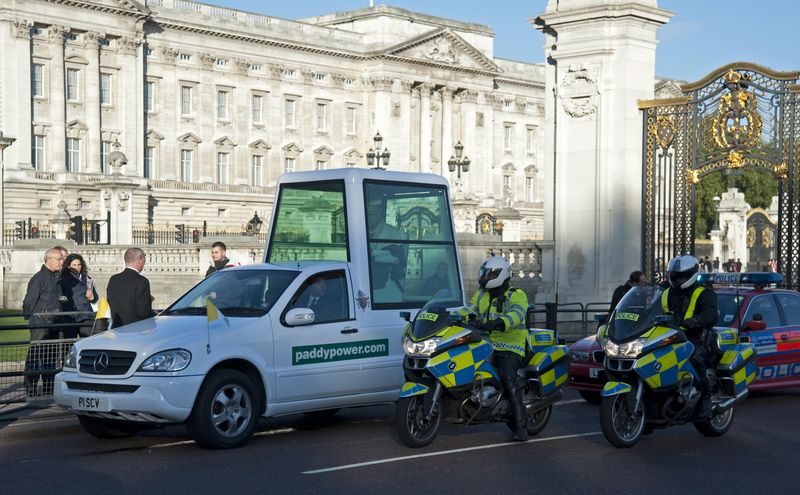
  • Bookmaker, Paddy Power, found a great way of brandjacking the Pope's visit to London.  A fake Popemobile, complete with fake Pope was seen touring all over London.

    On one occasion the police took an interest and the photographer managed to get this shot in which the Paddymobile appears to have police outriders.

    POPEMOBILE-07
     

    h/t @prcaingham, by the way.

  • Brandjack Ltd can engage in consultancy and training for businesses, government organisations or NGOs.

    With twenty years experience in Public Relations practice and education, Brandjack’s editor, Quentin Langley, has worked with blue chip brands as well as smaller organisations.  Quentin has worked in the Global Media Relations Office of Shell International at the time of the Nigeria crisis and is a former head of Global PR at Knight Frank.  For seven years he lectured in public relations and political communications at Cardiff University.

    Contact Quentin Langley on editor@quentinlangley,net or +44 7957 421338.